

AI Visibility in the Automotive Industry: Key Insights from Brantial’s 2026 Report
Discover how automotive brands perform in AI search. Brantial’s 5,000-prompt analysis reveals visibility trends, top brands, and key insights across AI models.
The automotive industry is rapidly becoming one of the most competitive verticals within AI-powered search ecosystems. As user behavior shifts from traditional search engines to AI-generated answers, brand visibility is no longer defined by rankings alone, but by whether a brand is referenced within AI responses.
At Brantial, we designed this study to measure how automotive brands appear across leading AI models. Using a dataset of 5,000 carefully structured prompts, we analyzed how brands are mentioned, how often they are cited, and how visibility differs across models. The goal was to move beyond traditional SEO metrics and introduce a more relevant framework for AI-driven discovery.
Methodology: Measuring Visibility Through 5,000 Prompts
To accurately reflect real user behavior, we built a prompt dataset covering a wide range of intents, including informational queries, product comparisons, and decision-stage searches.
Each prompt was systematically submitted to multiple AI models, and the responses were analyzed to identify which brands were referenced and in what context. This standardized approach allowed us to compare visibility across models and measure brand presence at scale.
Rather than focusing on rankings, we evaluated visibility based on how frequently a brand appeared within AI-generated answers. This approach reflects how users actually interact with AI systems today, where a single synthesized answer replaces a list of links.
Automotive AI Visibility Landscape
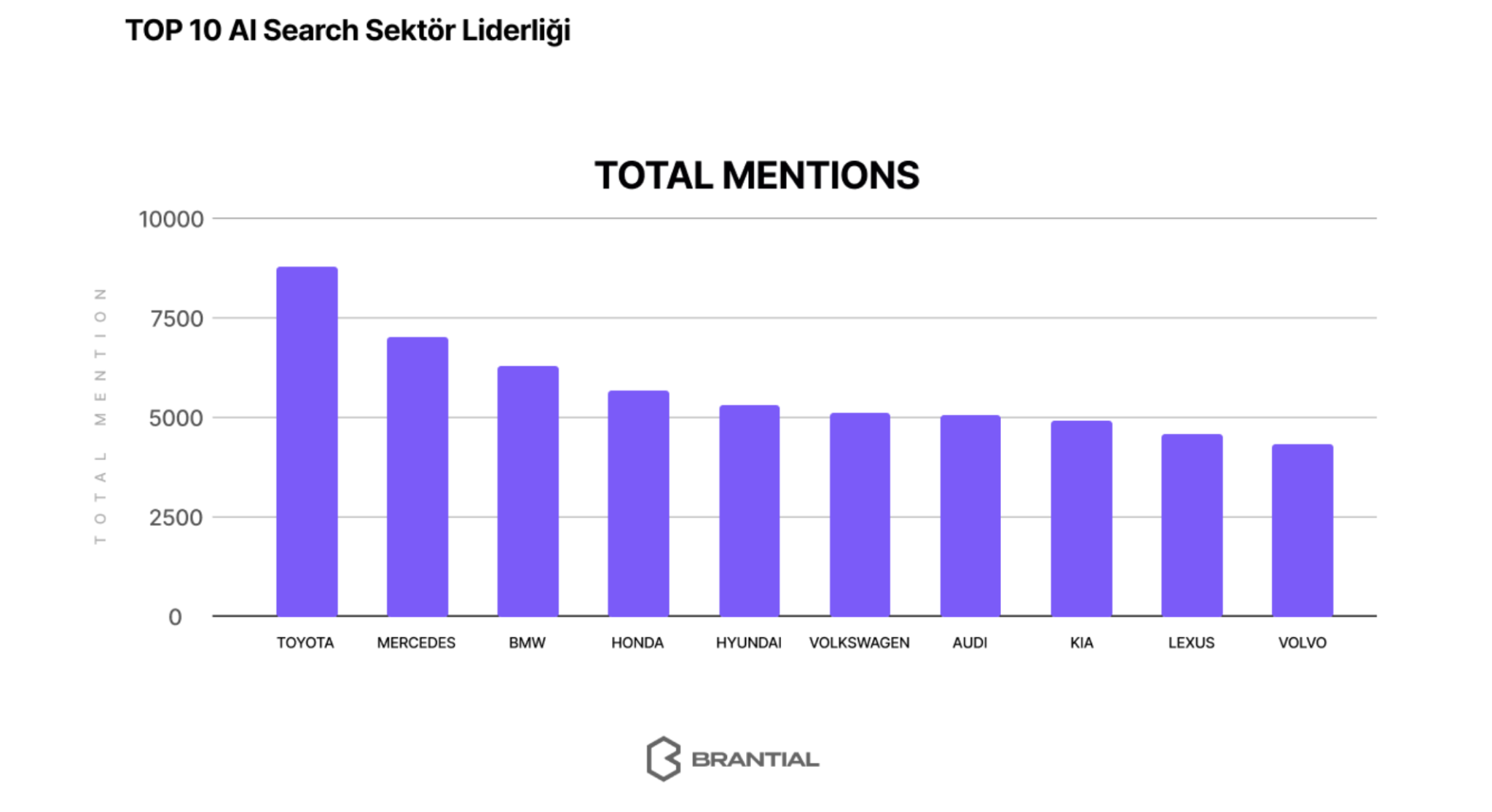
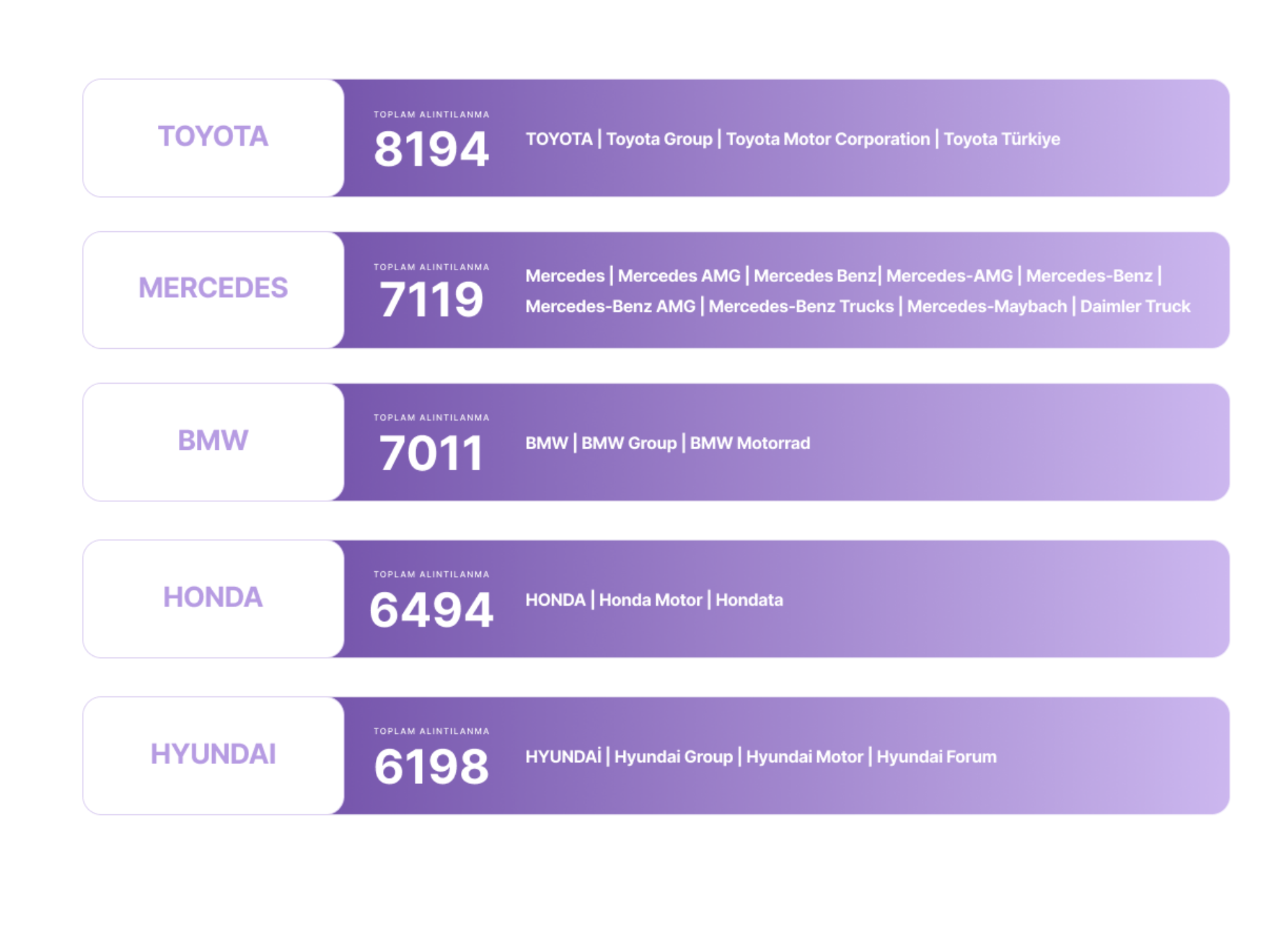
Our findings reveal a highly concentrated visibility distribution within the automotive sector. Brands such as Toyota, Mercedes-Benz, and BMW dominate AI-generated responses, securing the highest number of total mentions across the dataset.
In fact, the top 10 brands collectively generated over 59,000 mentions, with more than 35,000 of these belonging to the top 5 brands alone. This indicates a significant concentration of visibility among a small group of dominant players.
The gap between the most and least visible brands is substantial, highlighting a non-linear distribution where leading brands capture a disproportionate share of AI attention.
Model-Level Differences in Brand References
One of the most important insights from the report is that different AI models produce different brand distributions, even when given the exact same prompts.
Some models tend to reference specific brands more frequently, while others offer a more diversified set of results. Additionally, certain brands appear under multiple variations (such as sub-brands or model lines), which can impact how visibility is measured and interpreted.
This variability demonstrates that visibility in a single AI platform is not sufficient. Brands must adopt a multi-model strategy to ensure consistent presence across the broader AI ecosystem.
Understanding AI Visibility Score
To quantify brand presence, we developed the AI Visibility Score, a metric that measures how often a brand appears across the full prompt set.
The results clearly show a sharp divide between leading brands and the rest of the market. Top-performing brands maintain strong and consistent visibility, while many others appear only sporadically or not at all.
This creates a new competitive dynamic: in AI search, visibility is not incremental. Brands are either consistently present in answers or largely invisible.
The Future of Competition in AI Search
The shift from traditional search results to AI-generated answers fundamentally changes how competition works. Instead of competing for positions on a results page, brands now compete to be included within a single synthesized response.
This means that being “ranked” is no longer enough. Brands must become trusted sources that AI systems choose to reference. Visibility is no longer about position; it is about presence within the answer itself.
Strategic Implications for Brands
The findings of this report point to a clear transformation in digital visibility strategies. To succeed in AI-driven environments, brands must:
- Expand beyond their own websites and build presence across trusted third-party platforms
- Strengthen brand authority signals that AI systems rely on when generating answers
- Manage brand variations and entities consistently across sources
- Optimize for multiple AI models rather than focusing on a single platform
As AI continues to reshape how users discover information, Generative Engine Optimization (GEO) will become a central component of digital strategy.
At Brantial, we believe that the brands that understand and adapt to this shift early will be the ones that lead the next era of search.
Other Case Studies
Browse all case studiesAI Visibility Case Study: A Collagen Product Group in the Dietary Supplement Market
How a collagen product group achieved 98.7% AI visibility through non-branded, semantically structured content beyond traditional SEO.
2,400% Growth in ChatGPT-Originated Traffic for a Leading Financial Institution
A leading banking institution leveraged AI-optimized content and structured data to achieve a 2,400%+ increase in ChatGPT-driven user engagement.