

GEO vs SEO: The Differences, the Overlap and How to Do Both
SEO earns a place in the search results; GEO earns a place in the AI answer. See how GEO and SEO differ, where they overlap, and how to do both.
Key Takeaways: GEO vs SEO
5- SEO (search engine optimization) helps a page rank in Google and Bing results. GEO (generative engine optimization) helps a brand get named and cited in AI answers from ChatGPT, Gemini, Perplexity, Claude and Google AI Mode.
- They share most of their foundation. AI search engines read pages from search indexes, so a page that cannot be crawled or indexed rarely gets cited either.
- The differences are in the output and the measurement: a ranked position and clicks for SEO; mentions, citations and how the brand is described for GEO.
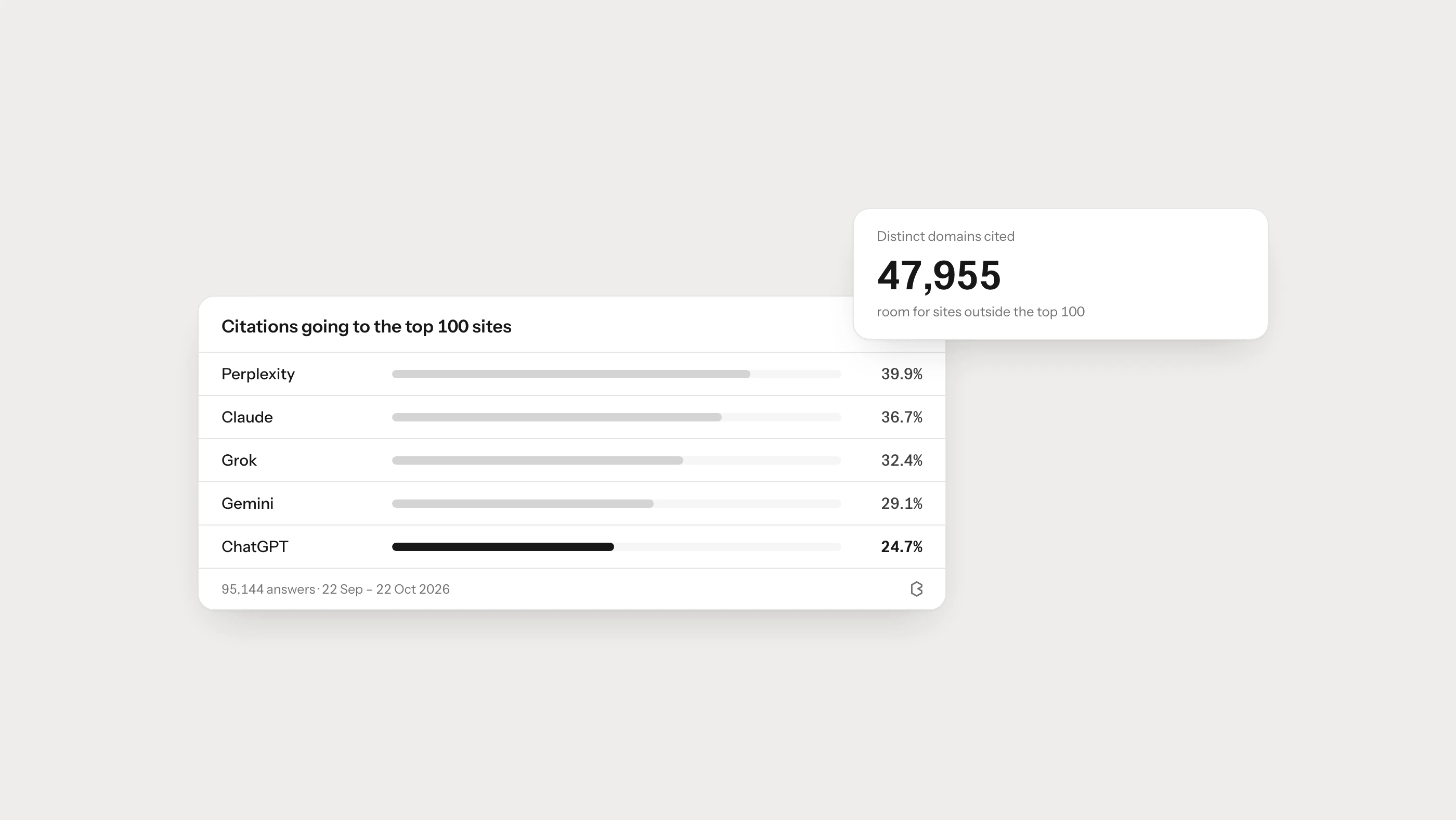
- GEO also depends more on what other sites say about you, and has to be measured per engine. In nearly 100,000 answers we measured, two engines answering the same question on the same day shared only about one in ten cited sites.
- Do not run them as two separate programmes. Start from SEO basics, then add answer-first content, consistent facts, third-party presence and AI visibility tracking.
The difference between GEO and SEO is where you want to appear. SEO (search engine optimization) works to get a page into the top results on Google or Bing. GEO (generative engine optimization) works to get a brand named, described correctly and cited inside the answers that ChatGPT, Gemini, Perplexity, Claude and Google’s AI Mode write.
They are not rivals. Most AI search engines look things up in a search index before answering, so a lot of good SEO is also good GEO. What changes is the result you are aiming for, the signals that carry extra weight and the way you measure success.
GEO vs SEO at a glance
| SEO | GEO | |
|---|---|---|
| Goal | Rank a page in search results | Get the brand named and cited in AI answers |
| Where it shows | Google and Bing results pages | ChatGPT, Gemini, Perplexity, Claude, Copilot, AI Overviews, AI Mode |
| What the user types | Short keywords | Long questions with context and follow-ups |
| What competes | Ten results on page one | The few brands and sources that make it into one answer |
| Unit of optimization | A page | A page, a passage and the brand as a whole |
| Success looks like | Position, impressions, clicks | Mention rate, citation rate, position in the answer, accurate wording |
| Measured with | Search Console, rank trackers, analytics | Prompt tracking across engines, source analysis |
| How stable it is | Rankings move over days and weeks | The same question can get a different answer each time |
AEO (answer engine optimization) is a third term you will see in the same conversations. It is older and covers any system that answers directly, including featured snippets and voice assistants. In practice, AEO and GEO now describe nearly the same work; our AEO guide covers the difference.
Where GEO and SEO overlap
More than many GEO articles suggest. When an AI engine searches before answering, it uses a search index: Google’s for AI Overviews, AI Mode and Gemini, Bing’s for Copilot, and its own crawlers and search partners for ChatGPT and Perplexity. Google says its AI features have no extra technical requirements beyond being indexed and eligible to show a snippet (Google Search Central).
So these SEO basics carry straight over:
- Crawlable, indexable pages. If a search bot cannot fetch a page, no engine can retrieve it. Check that you are not blocking the AI search bots you want to appear in.
- Main content in the HTML. Pages that only show their text after JavaScript runs are harder for crawlers to read.
- Helpful content that matches the question. Pages that answer a real question clearly are what both rankings and AI answers are built from.
- Clear structure. Descriptive headings and one topic per section help search engines understand a page and help AI pull out the right passage.
- Authority. Links and mentions from trusted sites still help a page rank, and pages that rank are more likely to be retrieved.
Where GEO and SEO differ
The answer, not the list
In SEO, ten pages share page one and the user picks. In AI search, the engine reads a handful of pages and writes one answer that usually names a few brands. Ranking sixth can still bring clicks; being sixth in line for an AI answer often means not being in it.
Passages, not just pages
AI engines quote and combine passages. A long page can be cited for one paragraph that answers a sub-question well. That rewards answer-first writing: the direct answer in the first sentences under a heading, with details after it. Our explainer on RAG shows why retrieval works this way.
The brand, not just the site
An AI answer can mention your brand without linking to you, or describe your product based on a review site, a forum thread or an old article. Consistent facts everywhere matter more: the same product names, prices, limits and positioning on your site, in directories, on review platforms and in press coverage.
More weight on other people’s pages
AI engines often cite comparison articles, reviews, Wikipedia and community discussions. In Brantial’s measurement of 99,626 answers between 21 September and 21 October 2026, Claude cited Wikipedia in a third of its answers, and Gemini regularly cited YouTube and Reddit. If the pages that AI trusts for your category discuss your competitors and not you, the answer will too.
Every engine is different
In SEO, Google is most of the market. In GEO, each engine searches a different index and cites different sites. In the same data, two engines answering the same question on the same day shared only 9% to 13% of the sites they cited. Visibility on ChatGPT says little about visibility on Perplexity or Gemini, so GEO is measured per engine. The AI search engine comparison has the full figures.
A different scoreboard
Search Console shows impressions and clicks, but not whether ChatGPT named you. GEO needs its own measurement: a fixed set of the questions your customers ask, run on each engine on a schedule, counting how often you are mentioned, where you appear in the answer and which sources are cited. That share is your AI visibility score.
Is GEO replacing SEO?
No. Search engines still send most referral traffic to websites, and AI engines depend on search indexes to find current pages. What is changing is that more research happens inside AI answers, and some of it never turns into a click. A brand that only tracks rankings can be losing ground in the answers without seeing it.
The practical view is that SEO is the foundation and GEO is the layer on top: it decides whether the pages you have earned a place for are actually used, and whether your brand is the one the answer recommends.
How to do GEO and SEO together
- Fix the shared foundation first. Crawlability, indexing, page speed, clean HTML and a sensible site structure help both.
- Write answer-first. Under each question-shaped heading, give the direct answer in one or two sentences, then the detail. Add the facts a comparison needs: prices, limits, sizes, supported markets, dates.
- Keep your facts consistent. Make sure your own pages agree with each other and with how directories, marketplaces and review sites describe you. Clear entity information helps AI recognise who you are.
- Earn third-party presence. Get included in the comparisons, reviews and community discussions that rank for your category. This is digital PR, and it helps SEO too.
- Measure both. Keep using Search Console for search. For AI answers, track your customers’ questions on each engine and watch mentions, citations and the sources behind them.
Frequently asked questions
What is the difference between GEO and SEO?
SEO aims to rank a page in Google and Bing search results and is measured in positions and clicks. GEO aims to get a brand mentioned and cited in AI-generated answers from ChatGPT, Gemini, Perplexity and Google AI Mode, and is measured in mentions, citations and how the brand is described.
Is GEO better than SEO?
Neither is better; they do different jobs. SEO still brings most organic traffic, and AI engines rely on search indexes, so GEO without SEO rarely works. Most brands need both, with SEO as the base.
Does good SEO help GEO?
Yes. Pages that are crawlable, indexed and clearly answer a question are the pages AI search engines retrieve. GEO adds answer-first writing, consistent brand facts, third-party presence and per-engine measurement on top.
What is the difference between SEO, AEO and GEO?
SEO targets search engine rankings. AEO (answer engine optimization) targets direct answers, such as featured snippets, voice assistants and AI answers. GEO targets answers written by generative AI models. AEO and GEO overlap so much that many teams use the terms interchangeably.
How do you measure GEO?
Pick the questions your customers ask, run them on each AI engine you care about on a regular schedule, and record whether your brand is mentioned, its position in the answer, whether your pages are cited and which other sources are used.