

AI Search Optimization Tools: How to Compare the Right Capabilities
A practical framework for comparing AI search optimization tools by coverage, metrics, source analysis, workflow support and decision value.
Key Takeaways: Choosing an AI Search Optimization Tool
4- Traditional SEO suites, content tools and AI visibility platforms solve different problems; feature counts are useful only after the use case is clear.
- A credible comparison checks prompt methodology, engine and market coverage, data freshness, answer-level evidence and exportable history.
- AI visibility should be measured with mentions, citations, position, source share, sentiment and competitor movement rather than one unexplained score.
- The best platform turns findings into owned actions and connects them to existing SEO, content, PR and analytics workflows.
The phrase “AI search optimization tool” now describes several very different products. Some help writers prepare content. Some add AI features to familiar SEO workflows. Others measure what ChatGPT, Gemini, Perplexity and similar systems say about a brand.
Those products are not interchangeable. A content editor cannot tell you reliably whether a brand was mentioned across a stable prompt set. An AI visibility platform does not replace technical crawling, backlink analysis or web analytics. The right comparison begins with the decision your team needs to make, not the longest feature list.
Start with the problem, not the vendor
Before booking demos, write down the outcome you expect from the tool. Most requirements fall into four groups.
1. Traditional search performance
This includes keyword rankings, organic traffic, backlinks, crawl diagnostics and indexing. Google Search Console, analytics platforms and established SEO suites remain the main sources for this work.
2. Content planning and production
These tools support briefs, topic research, on-page checks, drafting and editorial workflows. They can improve consistency and speed, but their recommendation scores should not be treated as proof that an AI engine will cite the page.
3. AI answer visibility
These platforms run prompts across answer engines and record which brands and sources appear. The useful outputs include mentions, citations, positions, sentiment, competitor share and changes over time.
4. Execution and governance
Measurement creates a backlog. Teams then need to decide who owns each action, whether it requires content, technical SEO, product information or third-party authority, and whether the change improved the result.
The capabilities worth comparing
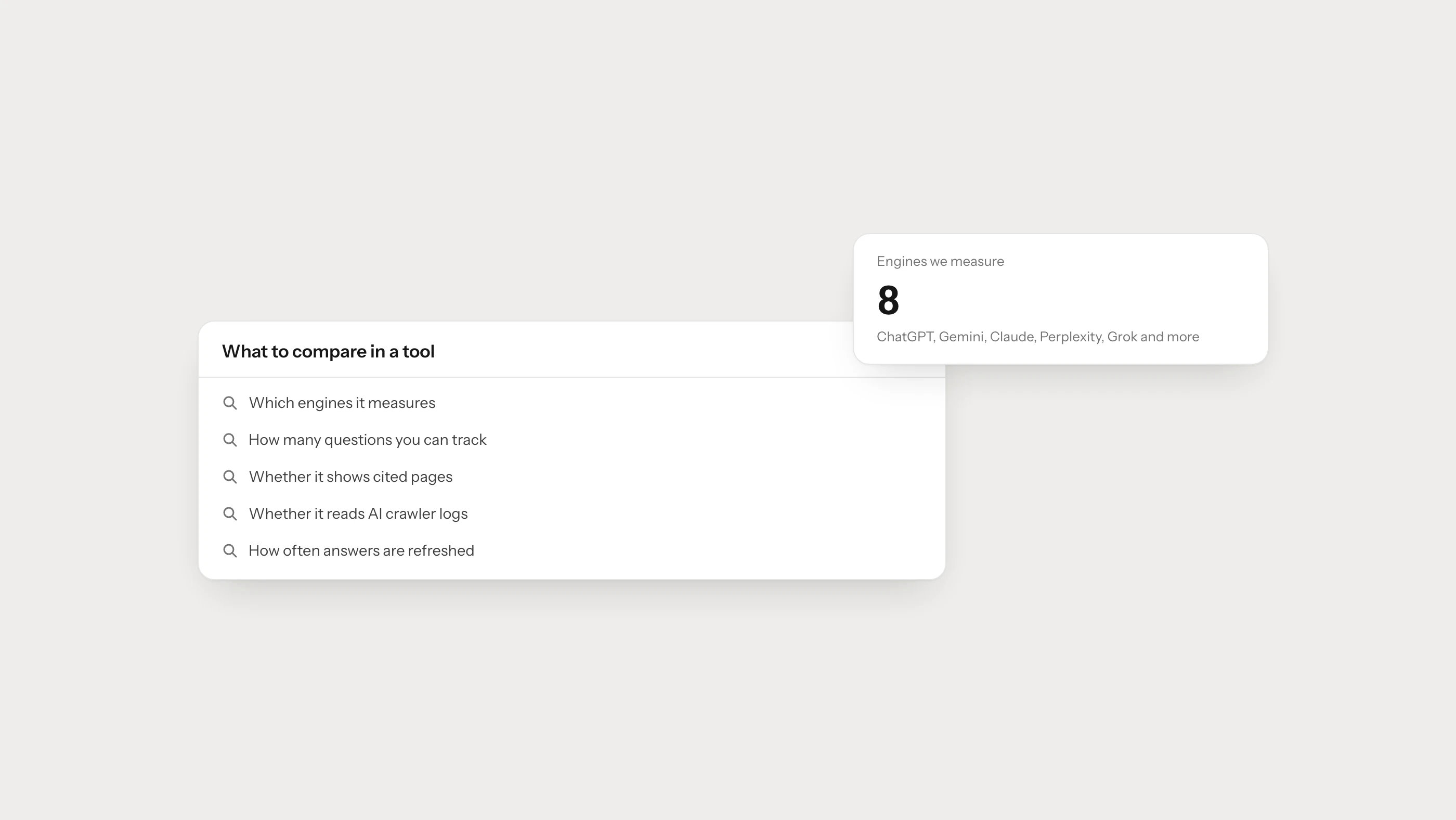
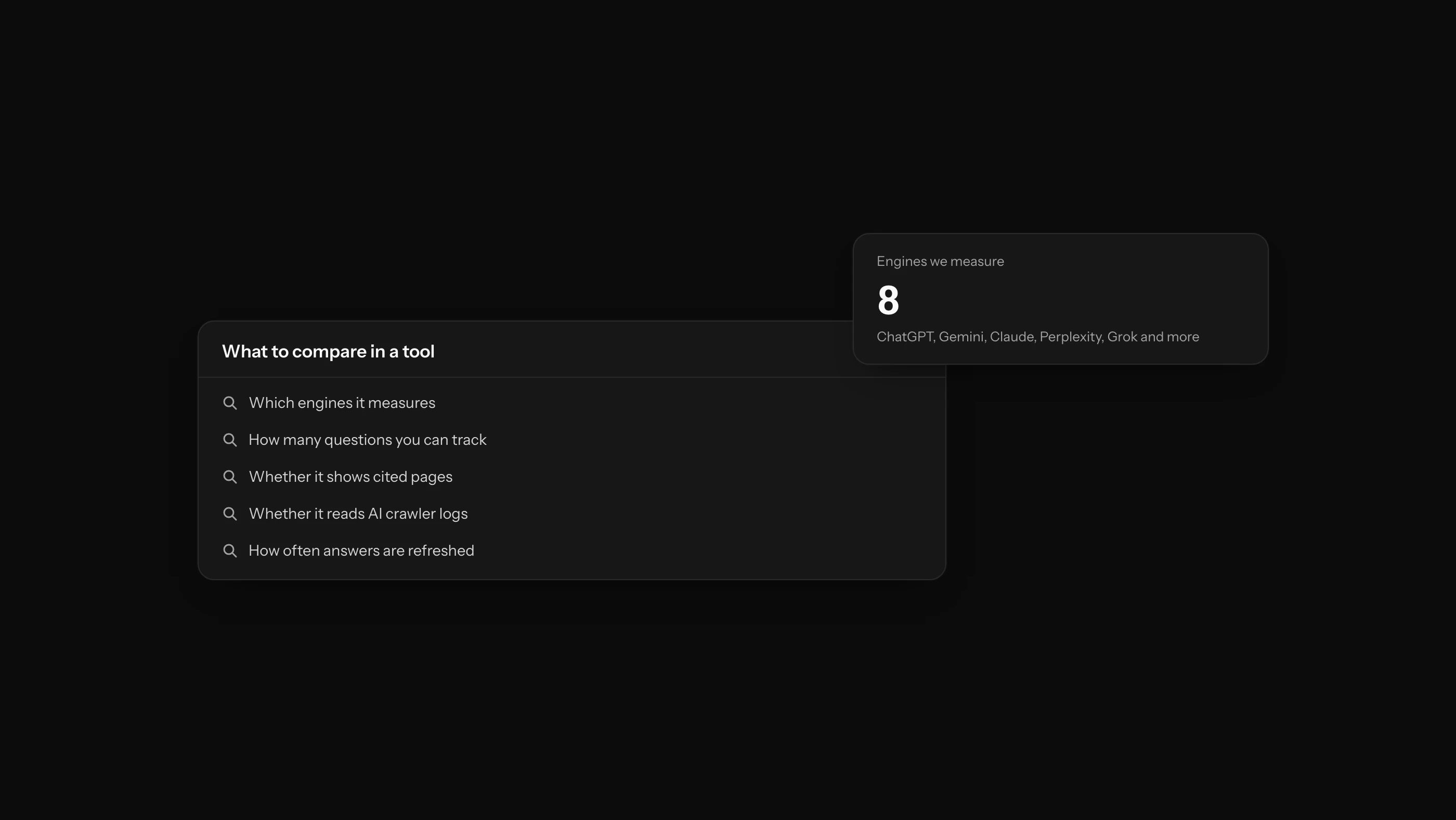
Use the same checklist for every platform. It prevents an impressive demo from hiding gaps that matter after purchase.
| Capability | Questions to ask |
|---|---|
| Prompt methodology | How are prompts selected, grouped and updated? Can we bring our own prompt set? |
| Engine coverage | Which answer engines, models, countries and languages are supported? |
| Measurement frequency | Are prompts run daily, weekly or on demand? Is historical data retained? |
| Answer evidence | Can we open the captured answer, source list and timestamp behind each metric? |
| Brand recognition | How are spelling variants, products and ambiguous brand names handled? |
| Citation analysis | Does the platform distinguish brand mentions from cited brand-owned URLs? |
| Competitor analysis | Can competitors be changed by market or prompt cluster? |
| Source intelligence | Can we see which domains and URL types influence the category? |
| Workflow | Can findings become assigned, trackable actions rather than an export? |
| Data access | Are exports, APIs and clear definitions available? |
Metrics should be explainable
A single visibility score is convenient, but it should never be the only evidence. Ask the vendor to show how the score is calculated and how it behaves when the prompt set or engine mix changes.
At minimum, an AI visibility platform should separate:
- Mention rate: the share of answers containing the brand
- Citation rate: the share using a brand-owned URL as a source
- Average position: the brand’s placement when an ordered answer is present
- Prompt coverage: the number of relevant prompt clusters measured
- Competitor share of voice: the relative presence of tracked brands
- Source share: the domains and pages most frequently cited
- Sentiment and accuracy: whether the description is favourable and factually correct
Read the answer behind the metric. A mention can be negative. A citation can support a competitor comparison. A rising score may come from adding easier prompts rather than stronger performance.
Data quality questions that reveal weak tools
AI answers vary. Good platforms do not hide that variability. They document the country, language, model, timestamp and prompt used for each run. They also retain enough history to distinguish a lasting change from a one-day fluctuation.
Ask these questions during evaluation:
- Can we reproduce the result from the stored prompt and answer?
- Does the platform show the denominator behind every percentage?
- How are retries, failed runs and model changes handled?
- Can we separate branded, category and comparison prompts?
- Can we filter by market, engine and date without changing the underlying sample?
- How does the system resolve brands with common or ambiguous names?
If these questions cannot be answered clearly, the dashboard may be better at presentation than measurement.
How the main tool categories fit together
Most teams do not need to choose one category and abandon the others.
| Tool category | Best used for | Does not replace |
|---|---|---|
| Search Console and analytics | Indexing, clicks, sessions and conversions | AI answer monitoring |
| SEO suite | Rankings, links, keyword research and technical audits | Answer-level mentions and citations |
| Content workflow tool | Briefs, editing and production consistency | Independent visibility measurement |
| AI visibility platform | Prompts, mentions, citations, sources and competitors | Core web analytics and technical SEO |
The stack should connect these layers. For example, an AI visibility gap can reveal a missing comparison page. Search Console can show whether the new page is indexed. Analytics can measure visits and conversions. Repeated answer tracking can show whether the brand later enters the shortlist.
Where Brantial fits
Brantial is built for the AI visibility and execution layer. It tracks prompt-level presence across answer engines, shows the sources and competitors shaping each answer, and turns findings into prioritised work.
The relevant modules include:
- Platform overview for AI visibility, source and competitor monitoring
- Prompt Volumes for deciding which prompt clusters matter
- AI Page Optimizer for moving approved improvements into production
- Site Health for technical readiness and page-level issues
This does not make classic SEO data obsolete. It adds the answer layer that rankings and sessions cannot describe on their own.
A simple buying process
Run the same test with every shortlisted platform:
- Choose 20 to 30 prompts from one real category.
- Include informational, comparison and purchase-oriented questions.
- Define the market, language, engines and competitors in advance.
- Compare captured answers, not only summary dashboards.
- Check whether the tool explains missing visibility and suggests an accountable next action.
- Repeat the sample after a meaningful change and examine whether the history remains comparable.
The best AI search optimization tool is not the one that claims to automate the entire discipline. It is the one that gives your team trustworthy evidence, makes the next decision clearer and fits the operating rhythm you can sustain.
You can create a Brantial account to test the visibility, source and competitor layers with your own category.