

LLM SEO: How to Get Found and Cited by AI Models
LLM SEO makes your content findable and citable for ChatGPT, Gemini, Claude and Perplexity. 89% of AI answers search the web first. Here is what to do.
Key Takeaways
5- LLM SEO is the work of making your content easy for AI models such as ChatGPT, Gemini, Claude, Perplexity and Grok to find, understand and cite when they answer questions.
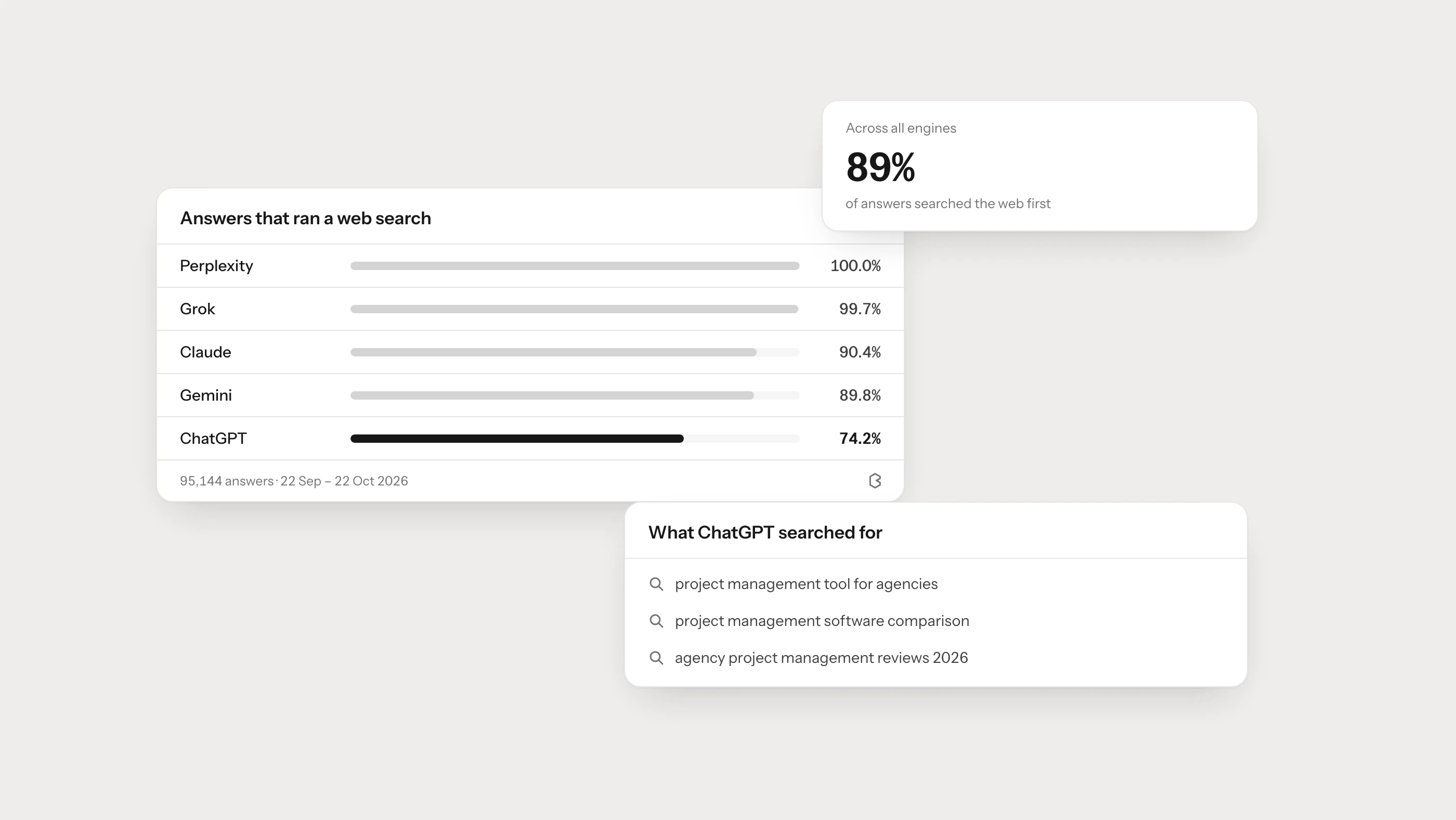
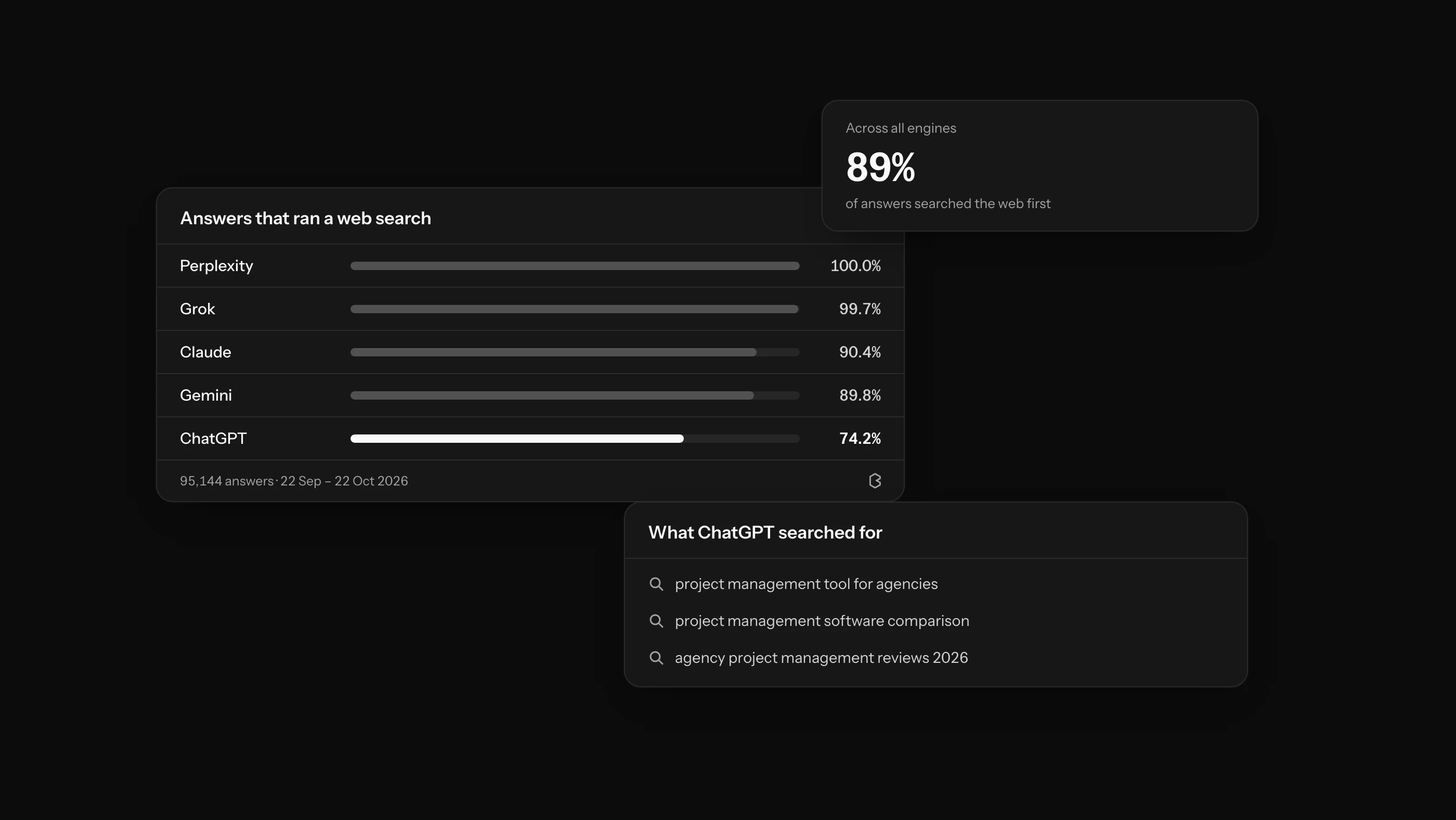
- Search still comes first. In 30 days of our data, 89% of AI answers ran a web search before answering; Perplexity and Grok almost always did, ChatGPT in 74.2% of answers.
- Ranking is the entry ticket, not the finish line. AI breaks a question into several searches, reads the results and quotes only the passages that answer it best.
- Engines disagree about sources, sharing only about one in ten, so LLM SEO has to be checked engine by engine.
- The core work is practical: let AI crawlers in, serve content as HTML, lead with the answer, cover the follow-up questions and be present on the sites each engine trusts.
LLM SEO is the practice of making your content easy for large language models to find, understand and cite. When someone asks ChatGPT, Gemini, Claude, Perplexity or Grok a question, the model usually searches the web, reads a handful of pages and writes an answer with links to its sources. LLM SEO is about being one of those pages, and about being described correctly when the model answers from memory instead.
It builds on classic SEO rather than replacing it. In our own data, 89% of AI answers started with a web search. If search engines cannot find and index your page, AI models usually cannot either.
Is LLM SEO different from SEO?
Partly. The foundations are the same: crawlable pages, clear structure, useful content and authority in your field. What changes is how the result is chosen and shown.
- A search engine ranks pages; an AI model writes one answer. There is no page two. You are either quoted, mentioned or absent.
- AI splits one question into several searches. A question like “which project management tool suits an agency?” may become searches for agency tools, software comparisons and recent reviews. This is called query fan-out, and your page can be found through any of them.
- Passages matter more than pages. The model lifts the few sentences that answer the question. A page that buries its answer in the fifth paragraph is easy to skip.
- Every engine behaves differently. In our study of which sites AI engines cite, two engines answering the same question on the same day shared only about 10% of their sources.
The terms LLM SEO, generative engine optimization (GEO) and answer engine optimization (AEO) describe much the same work. We compare them with classic search in SEO vs GEO.
How do AI models find your content?
There are two routes, and LLM SEO has to cover both.
1. Live search. The model searches the web while it answers, reads the pages it finds and cites some of them. Between 22 September and 22 October 2026 we recorded whether the engines searched before answering the questions our customers track:
| Engine | Answers that ran a web search |
|---|---|
| Perplexity | 100.0% |
| Grok | 99.7% |
| Claude | 90.4% |
| Gemini | 89.8% |
| ChatGPT | 74.2% |
Source: Brantial, 71,525 answers where the engine reported whether it searched. Engines queried through their APIs with web search available.
2. Model memory. When the model does not search, it answers from what it learned in training. A quarter of ChatGPT answers in our data came this way, and closer to a third for US questions, where ChatGPT searched in 68.6% of answers. Here there is no link to win; what matters is whether the model already knows your brand and describes it correctly. We cover that route in how LLMs learn about your brand.
LLM SEO checklist: what to do
1. Let AI crawlers reach your pages
Each engine has its own crawler. ChatGPT search uses OAI-SearchBot and Perplexity uses PerplexityBot; both are documented by the platforms in OpenAI’s crawler overview and Perplexity’s bot guide. Check that your robots.txt, firewall and CDN bot rules do not block them by accident. For Google, AI features and your website explains that AI Overviews and AI Mode use normal Search crawling and indexing.
2. Serve the important content as HTML
Most AI crawlers do not run JavaScript. If your prices, product details or answers only appear after scripts load, the crawler may see an empty page. Test it with our guide on whether AI crawlers can read JavaScript websites.
3. Lead with the answer
Put a direct, one-paragraph answer under each question-style heading, then explain. Use specific numbers, names and conditions. Short, self-contained passages are the ones models quote. Our guide to AI-friendly writing shows examples.
4. Cover the follow-up searches
Think about the searches a model will run for your topic: comparisons, “best for” questions, prices, alternatives and reviews with the current year. Pages that answer these directly are found through more of the fan-out searches.
5. Be present where each engine looks
AI engines cite ordinary websites most of the time, but each one leans on certain platforms. In our data Claude cited Wikipedia in 32.7% of its answers, Gemini cited YouTube in 8.5% and Reddit in 7.2%, and Perplexity cited marketplaces more than twice as often as average. Choose platforms by the engine that matters to you.
6. Keep your facts consistent
Use the same company name, product names, descriptions and key facts on your site, profiles, listings and press pages. Consistency helps models connect mentions to one entity and describe it correctly.
7. Treat llms.txt as optional
An llms.txt file is cheap to add, but none of the major engines has said it uses one for ranking or citing. Read our llms.txt guide before spending time on it.
How do you measure LLM SEO?
Rankings alone will not tell you whether LLM SEO is working. Track four things:
- Visibility: how often your brand appears in AI answers to the questions your customers ask, engine by engine. See what is AI visibility and how to measure it.
- Citations: which of your pages are cited, and which competitor or publisher pages are cited instead.
- Crawler visits: whether AI bots actually fetch your pages. Our AI crawler traffic guide explains how to read server logs.
- Referral traffic: visits that arrive from AI answers, covered in how to track traffic from AI search.
Answers change from day to day, so measure the same set of questions on a schedule and judge trends, not single answers.
Frequently asked questions
What is LLM SEO?
LLM SEO is the practice of making your content easy for large language models such as ChatGPT, Gemini, Claude and Perplexity to find, understand and cite in their answers. It builds on classic SEO and adds AI-specific work such as answer-first passages, AI crawler access and engine-by-engine measurement.
Is LLM SEO the same as GEO?
They describe largely the same work. GEO (generative engine optimization) and AEO (answer engine optimization) are other names for optimizing content so AI models and answer engines show it. LLM SEO puts the emphasis on the language models themselves.
Does classic SEO still matter for AI answers?
Yes. In our data 89% of AI answers ran a web search before answering, so pages that search engines cannot find or index rarely reach AI answers. Ranking is not enough on its own, though: the model still chooses which passages to quote.
How long does LLM SEO take to show results?
Changes to pages that engines already crawl can show up in AI answers within days, because most answers come from live search. Changes to what a model knows from training take much longer, as they depend on future model updates.
Do I need an llms.txt file for LLM SEO?
No. It does no harm, but none of the major AI engines has confirmed that it uses llms.txt to choose sources. Crawler access, HTML content and clear answers matter far more.