

Which Sites Do AI Engines Cite? Data From 639,334 Citations
We analyzed 639,334 citations from 95,144 AI answers. 92% pointed to ordinary websites, not Wikipedia or Reddit, and each engine leans on its own platforms.
Key Takeaways
5- 92% of the 639,334 citations we analyzed pointed to ordinary websites: brands, publishers, guides and niche sites. Encyclopedias, forums, video and social platforms together made up less than 4%.
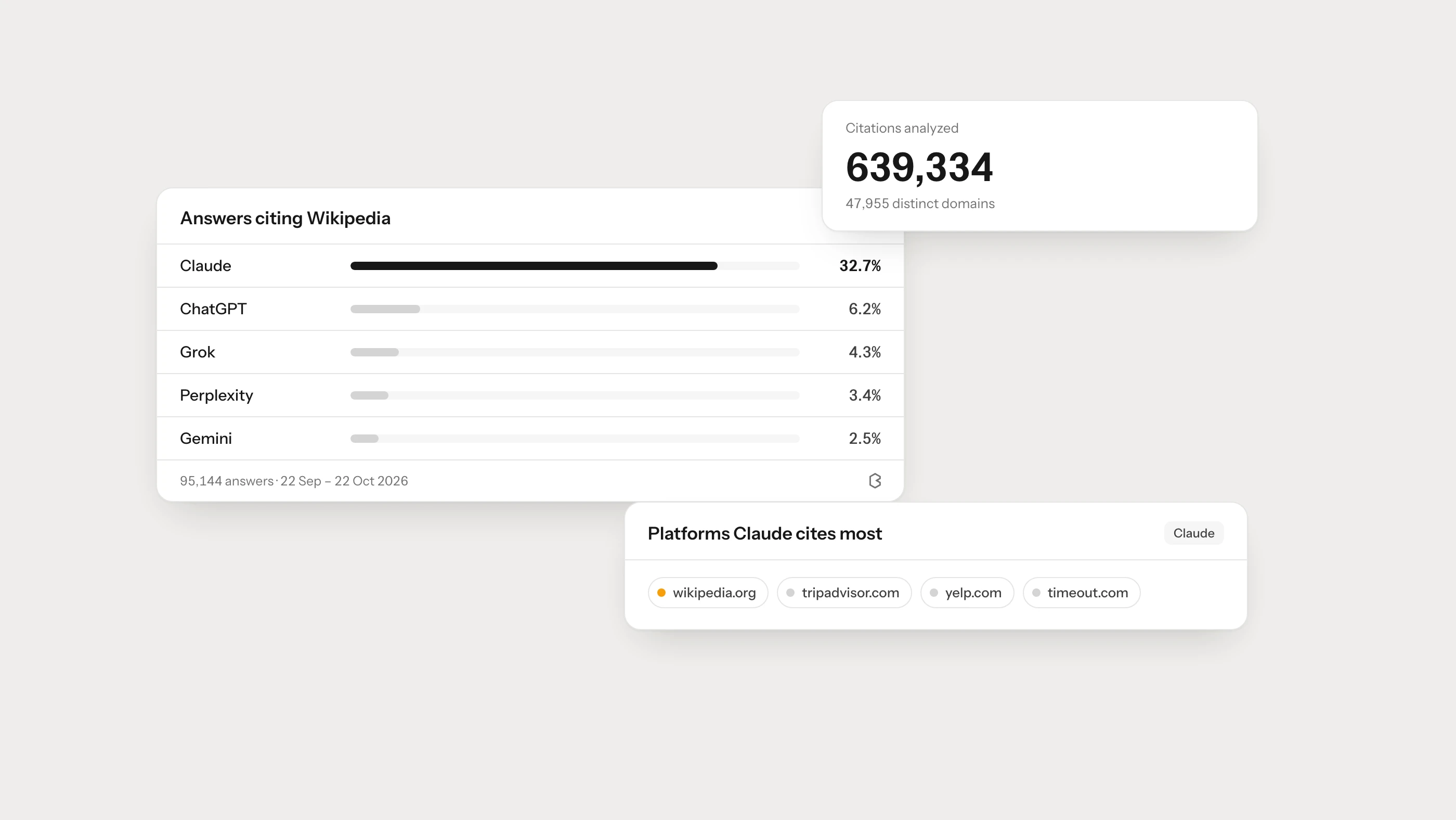
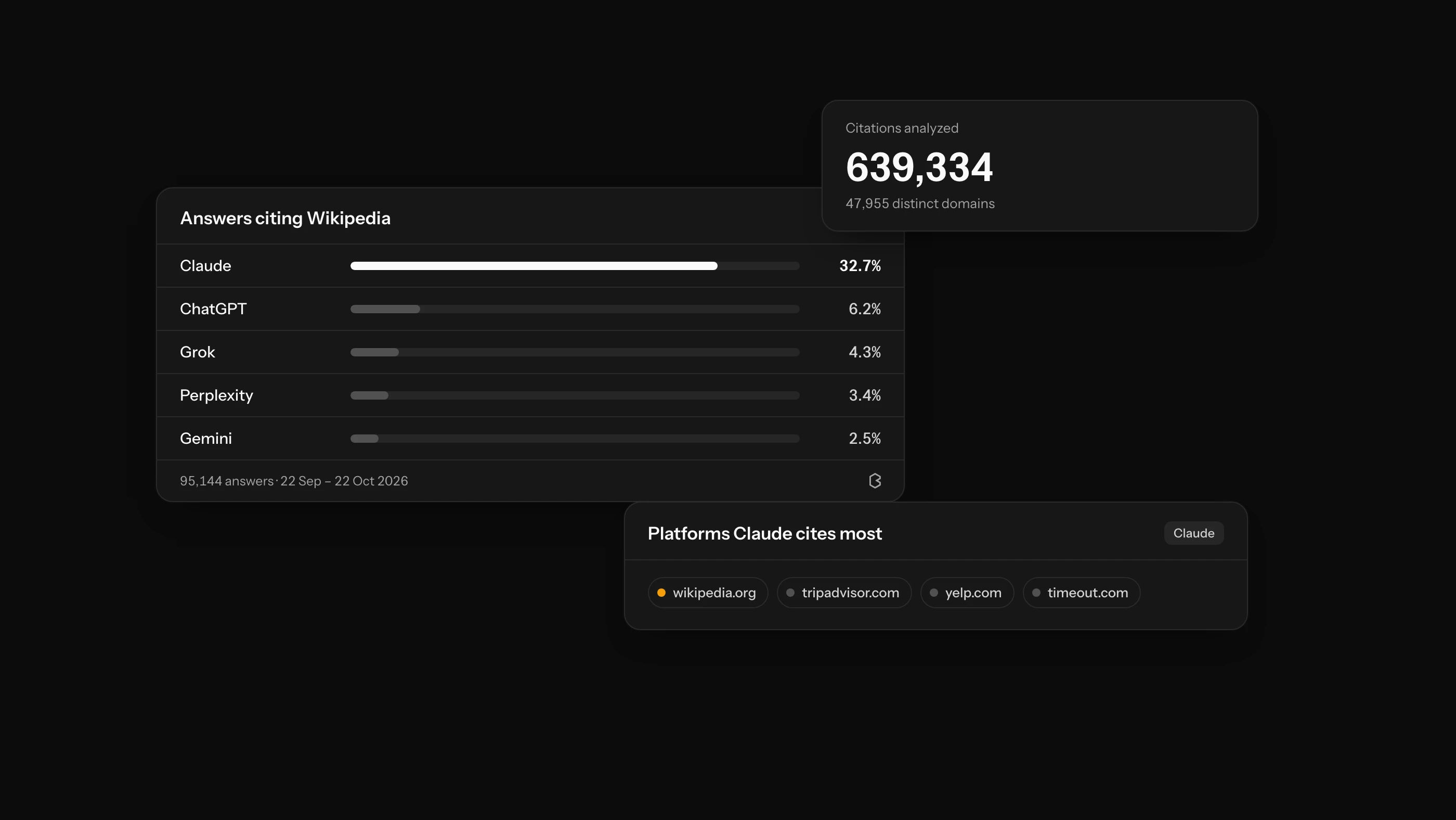
- Each engine has a platform it leans on. Claude cited Wikipedia in 32.7% of its answers; Gemini cited YouTube in 8.5% and Reddit in 7.2%; 8.6% of ChatGPT citations went to government and academic sites.
- Engines rarely agree. When two engines answered the same question on the same day, they shared about one source in ten, and 43.5% of the time they shared none.
- Perplexity cites the most sources per answer (14.6), ChatGPT the fewest (6.4). But ChatGPT spreads its citations widest: its 100 most-cited sites take only 24.7% of them.
- English-language answers lean harder on Reddit. Outside Turkey, Gemini cited Reddit in 18.3% of its answers; for US questions it cited YouTube in 19.5% and Reddit in 15.3%.
AI engines mostly cite ordinary websites, not the big platforms. We looked at 639,334 citations in 95,144 answers from ChatGPT, Gemini, Claude, Perplexity and Grok over 30 days. 92% of them pointed to brand sites, publishers, guides and niche sites. Wikipedia, Reddit, YouTube and LinkedIn are popular advice targets, but together with every other encyclopedia, forum, video and social site they took less than 4% of all citations.
The platforms still matter, just not equally everywhere. Each engine has its own habits, and those habits are strong enough that two engines answering the same question usually cite almost entirely different pages.
How we measured
The data comes from the questions Brantial tracks for its customers:
- 95,144 AI answers to 5,936 questions, collected between 22 September and 22 October 2026 across 344 brand projects.
- Five engines: ChatGPT, Gemini, Claude, Perplexity and Grok, queried through their APIs with web search available, using the models free users are served.
- 63,769 of the answers (67%) cited at least one source. Those answers contained 639,334 citations pointing to 47,955 different domains.
- Two views of the market. 76% of the questions are asked for Turkey. We therefore also report the same figures for every other market on its own (mostly the US, the UK and questions with no country set) and for US questions alone, so you can see what holds for English-language search.
A citation is a link the engine returned as a source for its answer. We grouped domains into types (encyclopedias, forums and Q&A sites, video, social networks, marketplaces, government and academic sites) and counted everything else as an ordinary website.
Which types of sites does AI cite most?
| Type of site | Share of citations |
|---|---|
| Ordinary websites (brands, publishers, guides) | 92.1% |
| Marketplaces | 2.1% |
| Government and academic sites | 2.1% |
| Social networks | 1.3% |
| Encyclopedias | 1.3% |
| Forums and Q&A sites | 0.6% |
| Video platforms | 0.5% |
Source: Brantial, 639,334 citations, 22 September – 22 October 2026.
This is the most useful number in the study for most brands. The work of being cited happens mainly on websites you can influence: your own pages, the publishers in your industry and the guides and comparison sites your customers read. It does not start with getting a Wikipedia article.
Does every AI engine cite the same sites?
No. Each engine leans on a different platform, and the differences are large:
| Platform | ChatGPT | Gemini | Claude | Perplexity | Grok |
|---|---|---|---|---|---|
| Wikipedia | 6.2% | 2.5% | 32.7% | 3.4% | 4.3% |
| YouTube | 0.5% | 8.5% | 1.1% | 1.4% | 1.1% |
| 2.1% | 7.2% | 0.0% | 2.3% | 0.3% | |
| 1.7% | 0.0% | 1.7% | 2.4% | 3.8% |
Share of each engine’s answers that cited the platform at least once.
- Claude relies on Wikipedia. One in three Claude answers cited it. After Wikipedia, the platforms Claude cited most were travel and local guides such as Tripadvisor, Yelp and Time Out, partly because many of the tracked questions are about places.
- Gemini is the video and community engine. It is the only one that regularly cites YouTube and Reddit, and it never cited LinkedIn in our data.
- ChatGPT favors official and academic sources. 8.6% of its citations went to government, university and research sites, four times the average.
- Perplexity leans on marketplaces. 4.5% of its citations pointed to marketplaces, more than double the average, which matters for anyone selling online.
- Grok cites LinkedIn most. 3.8% of its answers cited LinkedIn, the highest of the five engines.
If you want to be cited by a particular engine, the platform it trusts is worth more of your time than the platforms the others trust.
What changes in the US and other English-language markets?
The big pattern holds. Outside Turkey, 93.0% of citations still went to ordinary websites (15,683 answers, 151,322 citations). Each engine kept its favorite platform, but the platforms carry more weight in English-language answers, and Reddit most of all:
| Share of answers citing | All markets | Outside Turkey | US only |
|---|---|---|---|
| Reddit in Gemini | 7.2% | 18.3% | 15.3% |
| YouTube in Gemini | 8.5% | 10.9% | 19.5% |
| Wikipedia in Claude | 32.7% | 21.6% | 9.6% |
| Wikipedia in ChatGPT | 6.2% | 10.7% | 5.2% |
| Reddit in ChatGPT | 2.1% | 5.1% | 2.1% |
| Reddit in Perplexity | 2.3% | 5.3% | 6.3% |
Outside Turkey: 15,683 answers. US only: 1,717 answers, a smaller sample, so read it as a direction rather than a precise figure.
- Reddit matters far more in English. Outside Turkey, Gemini cited Reddit in almost one answer in five, and ChatGPT and Perplexity cited it more than twice as often as in the full data.
- For US questions, Gemini is a video and forum engine. It cited YouTube in 19.5% and Reddit in 15.3% of its US answers.
- Claude leans less on Wikipedia in the US. Its Wikipedia share fell from 32.7% overall to 9.6% for US questions.
- US answers favor official sources. Government and academic sites took 3.1% of US citations, against 2.1% overall, and marketplaces almost disappeared (0.1%).
How many sources does each engine cite?
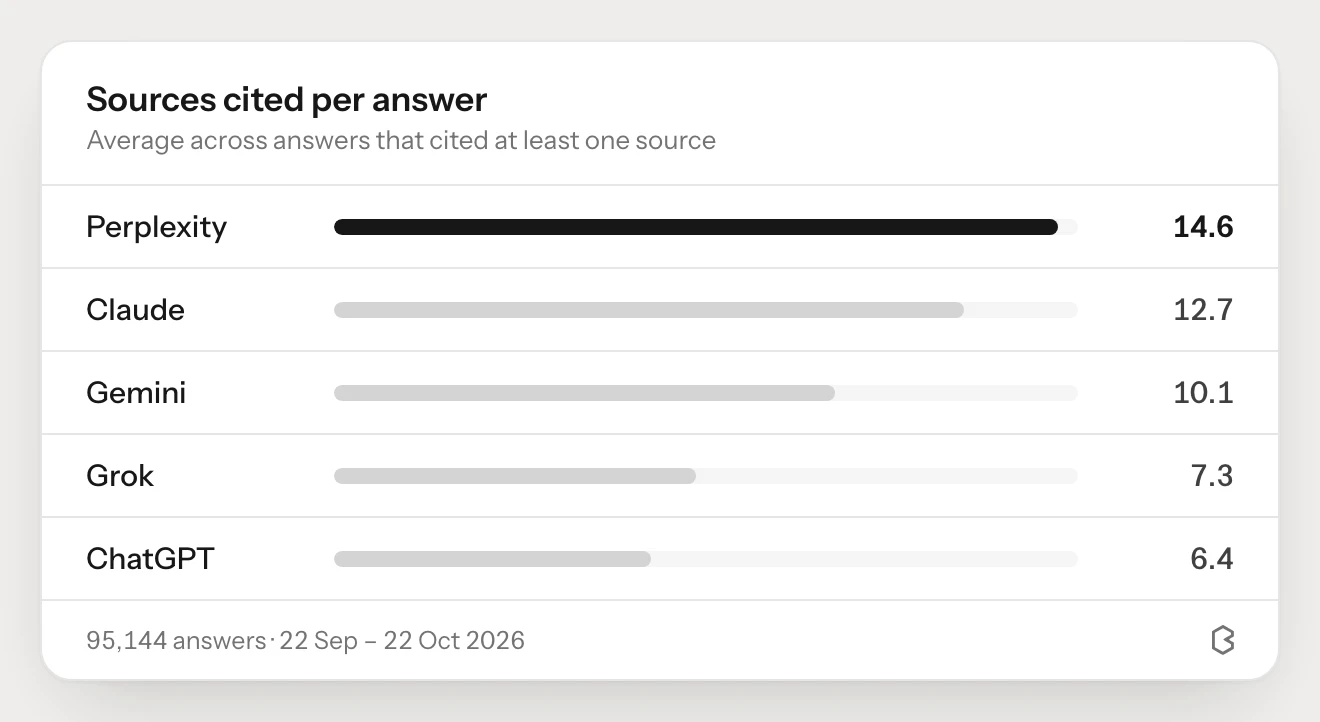
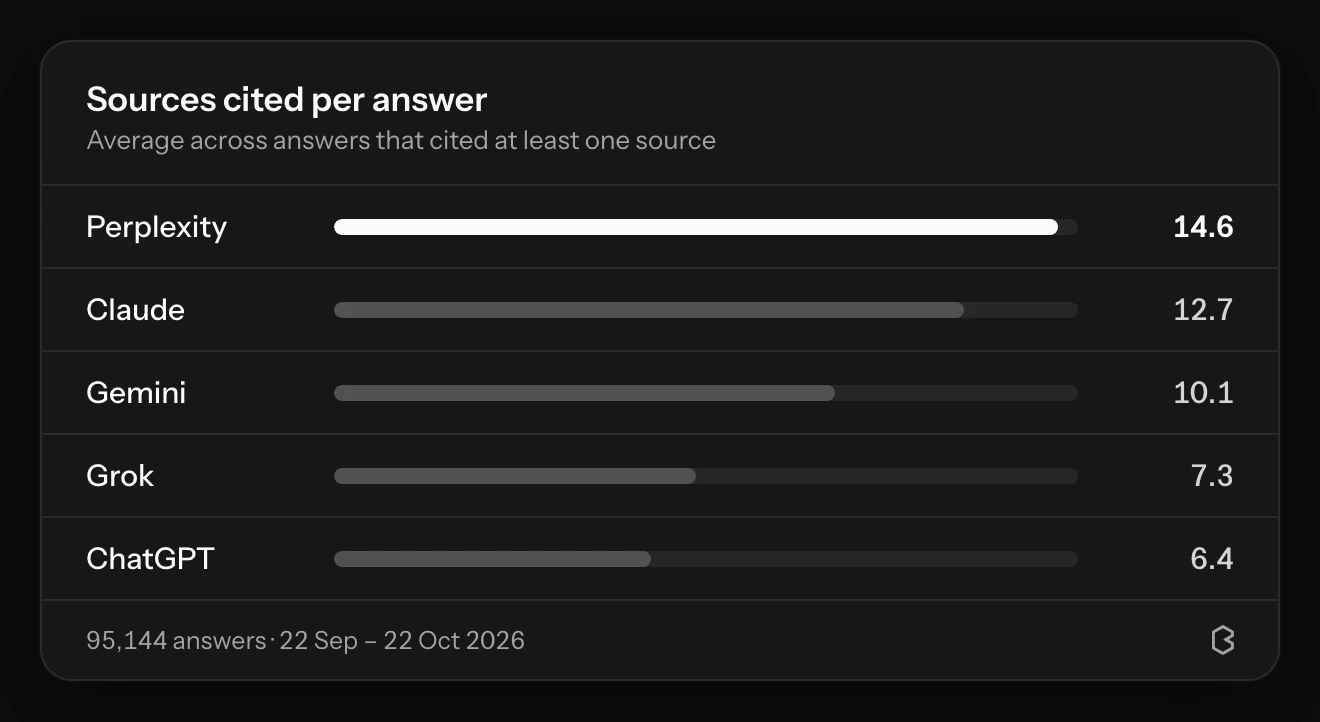
Perplexity cites 14.6 sources per answer on average, more than twice as many as ChatGPT’s 6.4. Claude (12.7) and Gemini (10.1) sit in between. More sources per answer means more chances to be included, but also less attention for each one.
Is AI citing the same few sites over and over?
Less than you might think. The 47,955 domains in the data form a very long tail.
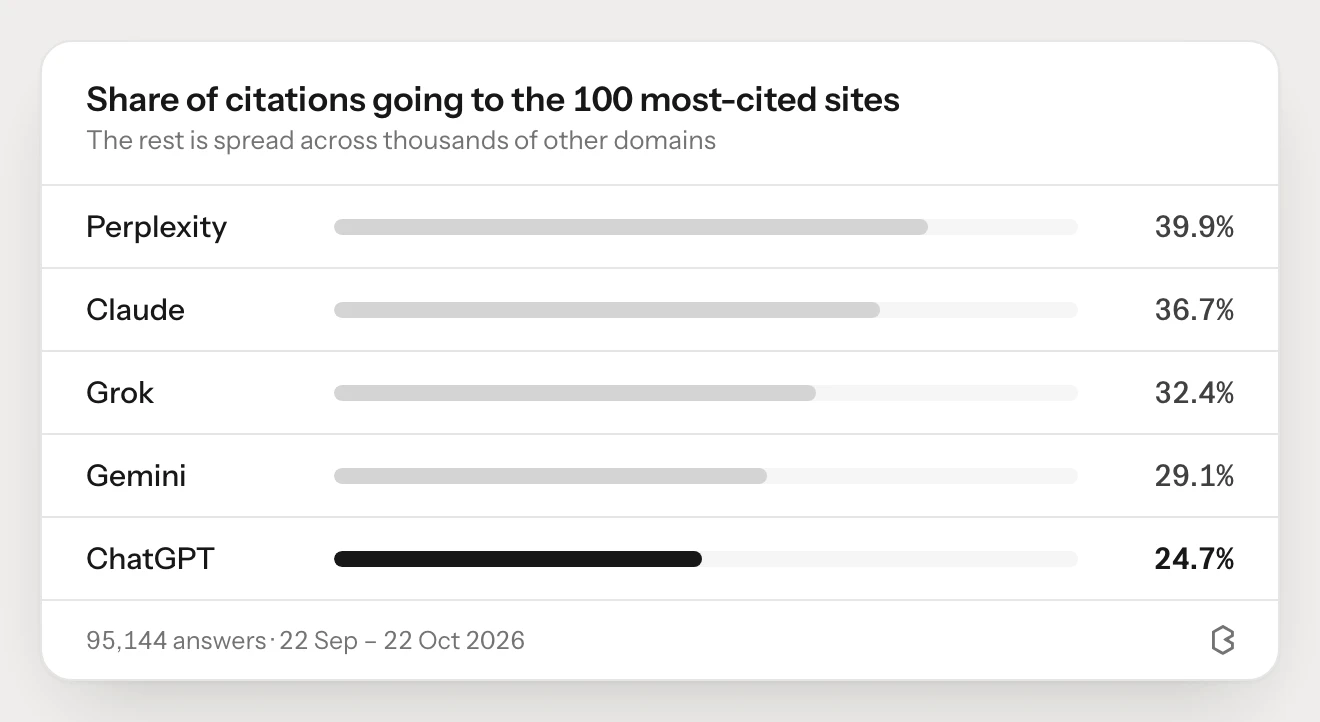
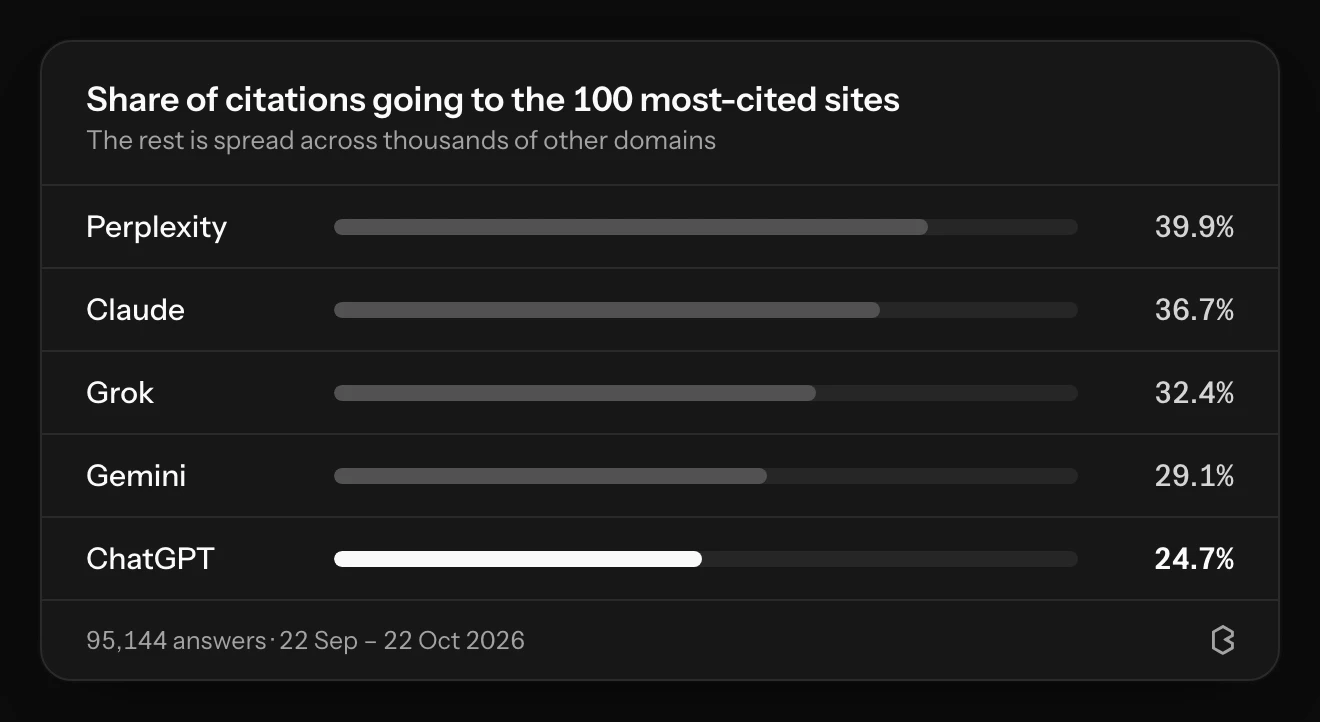
Even Perplexity, the most concentrated engine, gives only 39.9% of its citations to its 100 favorite sites. The other 60% are spread across thousands of domains. ChatGPT is the most open: its top 100 sites take just 24.7% of its citations, and it reached 18,446 different domains with fewer than 80,000 citations.
For a smaller brand, this is encouraging. There is room in the long tail for a site that answers a question better than anyone else.
Do AI engines agree on sources?
Rarely. We compared answers to the same question from two different engines on the same day, 4,829 pairs in all. On average the two answers shared about 10% of their sources. In 43.5% of the pairs they did not share a single source.
This is why a citation in one engine says little about the others, and why the same brand can look strong in Perplexity and invisible in Claude. We covered the reasons engines give different answers in why AI platforms show different answers.
What this means for your brand
- Start with the sites you control. Most citations go to ordinary websites. Clear, answer-first pages on your own domain are the foundation; our guide to getting cited by AI covers how to write them.
- Pick platforms by engine, not by habit. If Claude matters to you, check what Wikipedia says about your brand and category. If Gemini matters, look at YouTube and Reddit. If you sell online and Perplexity matters, your marketplace listings count.
- Get into the publications your category reads. Industry publishers and comparison guides make up a large part of the 92%. Find out which ones are cited for your questions and earn a place in them.
- Measure sources engine by engine. With so little overlap, one engine’s sources tell you nothing about another’s. Track the same questions across all of them; how many prompts to track explains how many you need for a reliable picture.
- Check pages that are read but not cited. An AI crawler visiting a page does not guarantee a citation. We explain the gap in AI read your page but did not cite it.
Frequently asked questions
Which websites does ChatGPT cite most?
Mostly ordinary websites: brands, publishers and guides. Compared with other engines, ChatGPT gives more weight to official and academic sources: 8.6% of its citations in our data went to government, university and research sites. It cited Wikipedia in 6.2% of its answers and Reddit in 2.1%.
Does AI cite Reddit a lot?
It depends on the engine and the market. In English-language markets Reddit is a real source for Gemini: outside Turkey it appeared in 18.3% of Gemini answers, and in 15.3% of Gemini answers to US questions. Perplexity and ChatGPT cited it in about 5% of answers outside Turkey, while Claude almost never did. Across all markets, forums and Q&A sites made up only 0.6% to 1.2% of citations.
Why does Claude cite Wikipedia so often?
In our data Claude cited Wikipedia in 32.7% of its answers, more than five times as often as any other engine. The engines do not publish how they pick sources, but the pattern was consistent across the month. If Claude matters for your brand, check that Wikipedia describes your category and company accurately.
How many sources does an AI answer cite?
It depends on the engine. Answers that cited at least one source contained 14.6 sources on average in Perplexity, 12.7 in Claude, 10.1 in Gemini, 7.3 in Grok and 6.4 in ChatGPT.
Can I see which sites AI cites for my own brand?
Yes. Brantial records every source the engines cite for the questions you track, grouped by domain and page, so you can see which sites shape the answers about your brand and your competitors.