

AI Brand Perception: How Does ChatGPT See Your Brand?
Learn how ChatGPT and other answer engines form brand perception, how to audit attributes, objections and sources, and how to improve inaccurate or weak positioning.
Key Takeaways
5- AI brand perception is not just sentiment. It includes the attributes, strengths, objections, comparisons and factual claims attached to a brand in generated answers.
- A high mention rate can hide a positioning problem. A brand may appear often while being described as expensive, complex, outdated or unsuitable for the audience that matters.
- Perception should be measured by prompt, persona, market and answer engine because the same brand can be framed differently in each context.
- The most useful audit connects each recurring description to the exact answer and source that influenced it.
- Improvement comes from correcting product facts, strengthening owned pages and influencing the trusted third-party sources answer engines use.
Your brand can appear in an AI answer and still lose the customer.
ChatGPT may mention your company but describe it as the expensive option. Gemini may present it as suitable for enterprises while overlooking the plan built for small teams. Perplexity may repeat an old limitation that was removed months ago. Visibility tells you that the brand entered the answer. It does not tell you what impression the answer created.
That impression is AI brand perception: the collection of attributes, strengths, objections, comparisons and factual claims that answer engines repeatedly attach to a brand.
This guide explains how to audit that perception without relying on one manual chat, how to find the sources shaping it and how to decide what should actually be changed.
What is AI brand perception?
AI brand perception is the way answer engines characterize a brand when they explain, compare or recommend options. It can include direct statements such as “easy to use” or “best suited to enterprise teams,” but it also appears through subtler choices:
- which use cases the brand is included in
- which audiences it is recommended to
- which strengths are mentioned first
- which drawbacks are repeated
- which competitors are presented as better alternatives
- which prices, features and policies are stated as facts
- which sources are used to support those descriptions
This is different from the brand message on your homepage. AI systems build answers from a broader information environment that can include your website, documentation, reviews, comparison pages, news coverage, communities and older pages that are still accessible.
The result may align with your intended position, partially reflect it or contradict it.
Visibility and perception answer different questions
Visibility asks whether the brand appeared. Perception asks what the answer taught the user about the brand.
| Signal | Question it answers | Example |
|---|---|---|
| Mention rate | How often does the brand appear? | The brand appears in 54% of tracked answers. |
| Answer position | Where is it placed among alternatives? | It is usually the third recommendation. |
| Sentiment | Is the language favorable, mixed or negative? | Ease of use is praised, but support is criticized. |
| Attribute association | What is the brand known for? | “Secure” and “enterprise-ready” appear repeatedly. |
| Objections | What may stop someone choosing it? | Price and implementation time are common concerns. |
| Accuracy | Are the claims current and correct? | An old plan limit is still being repeated. |
| Source influence | Which pages support the narrative? | A review page drives the pricing objection. |
A single visibility score cannot replace these signals. A brand may have strong visibility but weak consideration if most answers frame it as a poor fit for the target buyer. Another may appear less often but be recommended with a clearer reason to choose it.
If you need the measurement baseline first, start with our guide to AI visibility and the metrics used to track it. Brand perception is the next layer: it explains what those appearances actually communicate.
Why AI descriptions can differ
There is no single permanent description stored for every brand. The answer changes with the question, user context, model, location and sources available at that moment.
The prompt changes the frame
“Best project management software” invites a broad shortlist. “Project management software for a regulated bank with 500 users” introduces security, procurement and scale. A brand can be described differently even when both questions concern the same category.
This is why generic brand prompts are not enough. The audit needs the real decisions customers make, including budget, use case, industry, team size and important constraints.
The audience can change the recommendation
Persona details may alter both the brands mentioned and the sources selected. Even when the underlying question remains the same, changes in age, income, occupation, company size or use-case context can lead answer engines to prioritise different needs and produce different recommendations.
The practical lesson is not to create a stereotype for every audience. It is to test whether the customers you actually serve are recognized. An aggregate result can look healthy while the brand is missing from answers produced for its most valuable segment.
Models use different evidence
ChatGPT, Gemini, Perplexity, Claude and Copilot do not always retrieve the same pages or interpret them in the same way. One may rely on product documentation, another on editorial comparisons, and another on discussions or reviews.
Cross-platform differences are therefore evidence, not noise to average away. They can reveal which parts of the public brand story are strong and which depend on one source ecosystem.
For a closer look at that information environment, see how LLMs learn about a brand.
Old information remains discoverable
A retired pricing page, an outdated help article or a three-year-old review can continue to influence answers. Updating the current product page does not automatically remove every conflicting statement elsewhere.
When an incorrect claim recurs, search for the wording and inspect the cited pages before rewriting new content. The problem may be an old page you still own.
How to audit AI brand perception
A useful audit should be repeatable. Asking ChatGPT “What do you think of our brand?” once can produce ideas, but it cannot show frequency, platform differences or change over time.
1. Define the intended position
Write down three to five attributes the business genuinely wants to own. They should be specific enough to test and true enough to defend.
For example, “good quality” is too broad. “Fast setup for multi-location retail teams” creates a testable connection between capability, audience and outcome.
Also record facts that must remain accurate, such as starting price, supported countries, integrations, limits and security certifications.
2. Build prompts around real decisions
Use several prompt groups so the audit captures both direct and indirect perception.
| Prompt group | What it reveals | Example |
|---|---|---|
| Category discovery | Unaided visibility and associations | What are the best payroll tools for a 50-person company? |
| Attribute | Ownership of a desired position | Which payroll tool is easiest to implement? |
| Comparison | Relative strengths and objections | Brand A vs Brand B for a UK business |
| Persona | Fit for a priority audience | Which option suits a first-time HR manager? |
| Objection | Barriers to purchase | What are the drawbacks of Brand A? |
| Fact check | Accuracy of product knowledge | Does Brand A support SAML SSO? |
Avoid writing every prompt around the brand name. Category and problem-led questions show whether the brand enters consideration without being explicitly requested.
3. Keep the measurement context stable
Record the answer engine, country, language, date and prompt wording. If you are comparing before and after a change, keep those variables stable.
AI answers naturally vary, so repeated measurements are more reliable than a screenshot from one run. The goal is to identify persistent patterns, not react to every sentence that changes.
4. Review the full answer, not only the score
Read the exact passage around each mention. Capture:
- the position of the brand in the answer
- positive, mixed or negative language
- recurring attributes and use cases
- objections and caveats
- factual claims that can be verified
- competitors mentioned in the same context
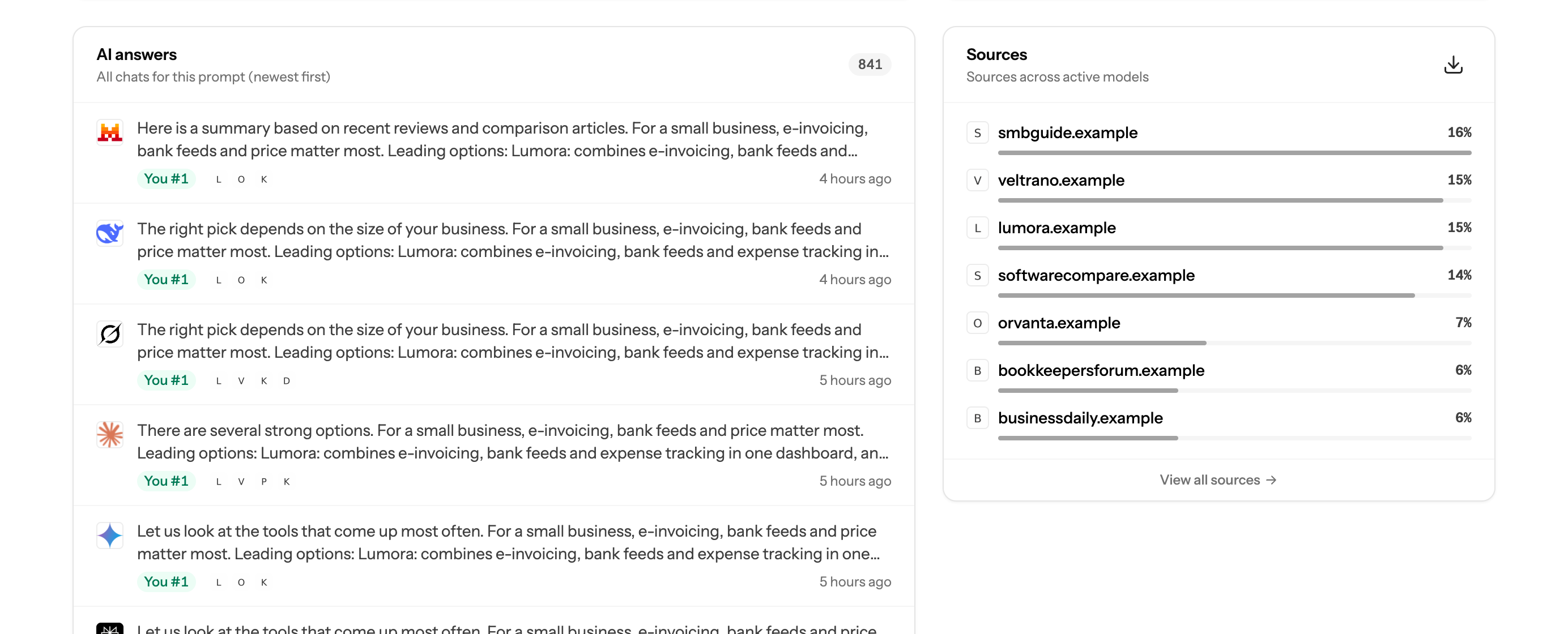
- sources attached to the relevant claim
A sentiment label is useful, but it needs context. “Premium” may be positive in a luxury category and an objection in a budget comparison. “Simple” can mean easy to use or too limited, depending on the sentence.
5. Compare the pattern with competitors
Do not ask only whether your own sentiment is positive. Compare which attributes each competitor owns and which objections follow them.
You may discover that every brand in the category is criticized for implementation time. That is a category problem. If only your brand receives that objection, it is a brand-specific issue worth investigating.
The same applies to strengths. Being called “reliable” is less distinctive if every competitor receives the same description. A useful positioning opportunity is both relevant to the buyer and meaningfully under-owned by alternatives.
6. Trace the description back to its source
The actionable unit is not “AI thinks we are expensive.” It is:
This pricing objection appeared in 18 answers across two engines and was repeatedly supported by these three pages.
Now the team can inspect whether the source is accurate, outdated, incomplete or based on a real product issue.
How to classify what you find
Not every unwanted description should be treated as a content problem.
Incorrect fact
The answer repeats an old price, missing feature or unsupported limitation. Correct the authoritative page, remove or redirect stale owned pages and make the current fact easy to verify.
Underrepresented strength
The capability exists, but answer engines rarely associate it with the brand. Strengthen the relevant product page with explicit use cases, evidence and internal links. Then consider whether credible third-party coverage also needs the updated story.
Fair objection
The criticism is accurate. Marketing should not try to bury it. Product, sales or customer success may need to address the underlying issue. Content can clarify the trade-off and explain who the product is and is not for.
Misleading comparison
The brand is being compared in the wrong category or against alternatives built for a different audience. Clarify category language, target use cases and differentiation across key owned pages.
Persona gap
The brand performs well in aggregate but disappears for a priority audience. Review whether your content clearly connects the product to that audience’s constraints, vocabulary and decision criteria.
How to improve AI brand perception
Make product facts easy to verify
Maintain clear pages for pricing, features, limits, availability, integrations and policies. Use precise language and visible update context where facts change regularly. Conflicting statements across your own site weaken the correction.
Build evidence around the position you want
If the brand wants to be known for fast implementation, publish more than the phrase “fast to implement.” Document the process, prerequisites, typical timeline, migration support and customer evidence. A claim becomes reusable when its conditions are clear.
Improve the page connected to the prompt
Do not force every attribute onto the homepage. Match the fix to the intent. A security association belongs on maintained security and procurement pages. A use-case association belongs on a focused solution page. A comparison question may require an honest decision guide.
Work beyond owned content
AI systems may rely on sources you do not control. Reviews, communities, independent comparisons, industry publications and partner pages can all reinforce or challenge your positioning.
This does not justify manufactured reviews or disguised promotion. It means PR, partnerships and customer advocacy should understand which sources already shape the category conversation and where accurate information is missing.
Measure after the source can change
Allow time for updated pages to be crawled and used. Compare the same prompt groups, markets and engines. Look for movement in the description, sources and competitive position, not only a higher mention count.
Common mistakes
Treating one answer as the truth
One answer is an example, not a trend. Repeat important prompts and review several engines before assigning work.
Reducing perception to positive or negative
Sentiment without the topic can hide the decision. A brand may receive positive language for design and negative language for price. The useful question is which attribute changed and for which audience.
Trying to erase every objection
Credible answers include trade-offs. The goal is accurate positioning, not universal praise. An honest limitation can help the right customer choose with confidence.
Publishing corrective content without fixing the source
If an outdated documentation page causes the error, another blog post may create more conflicting information. Correct or consolidate the authoritative source first.
Changing prompts after every result
A stable prompt set is necessary for measurement. Add new prompts when the market changes, but preserve the core group used for comparison.
Frequently asked questions
Is AI brand perception the same as sentiment analysis?
No. Sentiment measures the tone of a statement. Brand perception also includes attributes, audience fit, objections, comparisons, factual accuracy, answer position and the sources influencing those descriptions.
Can a brand have high visibility and poor perception?
Yes. It may appear frequently but be framed as expensive, difficult to implement or unsuitable for the target buyer. Visibility and perception should be read together.
Which AI platforms should be monitored?
Monitor the answer engines your audience uses and compare more than one. ChatGPT, Gemini, Perplexity, Claude and Copilot can use different sources and produce different competitive frames.
How often should perception be reviewed?
Track priority prompts continuously or at a consistent interval. Review the underlying answers when a major product, pricing, competitor or source change occurs. A quarterly strategic review is useful, but important risk prompts may deserve weekly attention.
Can schema markup fix an incorrect brand description?
Schema can help systems understand entities and visible page information, but it cannot override stale pages, weak evidence or influential third-party sources. Correct the factual source and make the information consistent across the wider web presence.
The practical conclusion
AI brand perception is not an abstract reputation score. It is visible in the words answer engines use when they recommend, compare and explain your brand.
Start with the audiences and decisions that matter. Measure recurring attributes, objections and factual claims across stable prompts. Compare engines and competitors, then trace each important pattern to the sources behind it. Some findings will require a content update. Others will belong to product, PR, customer experience or documentation.
The goal is not to make every AI answer flattering. It is to make the brand’s position accurate, distinctive and supported by evidence wherever customers ask for help deciding.