

How Long Do AI Citations Last? 52,160 Citations Tracked
We tracked 52,160 AI citations day by day. ChatGPT drops three in four of the pages it cites by the next day; after four weeks, at most a third remain.
Key Takeaways
5- AI citations are short-lived. Asked the same question the next day, ChatGPT cited the same page again only 26.7% of the time. Gemini kept 49.4%, Grok 54.8% and Perplexity 72.0%.
- Half of all citations are gone within one to three days: in less than a day on ChatGPT, about a day on Gemini, about two days on Grok and about three days on Perplexity.
- After four weeks, at most a third survive: 11.2% of ChatGPT citations, 18.8% on Perplexity, 27.1% on Gemini and 32.3% on Grok.
- Sites last longer than pages. ChatGPT kept the same site 47.1% of the time the next day, almost twice as often as the same page, because it often swaps one page of a site for another.
- A citation is a moment, not a position. The only reliable picture comes from asking the same questions again and again and counting how often you are cited.
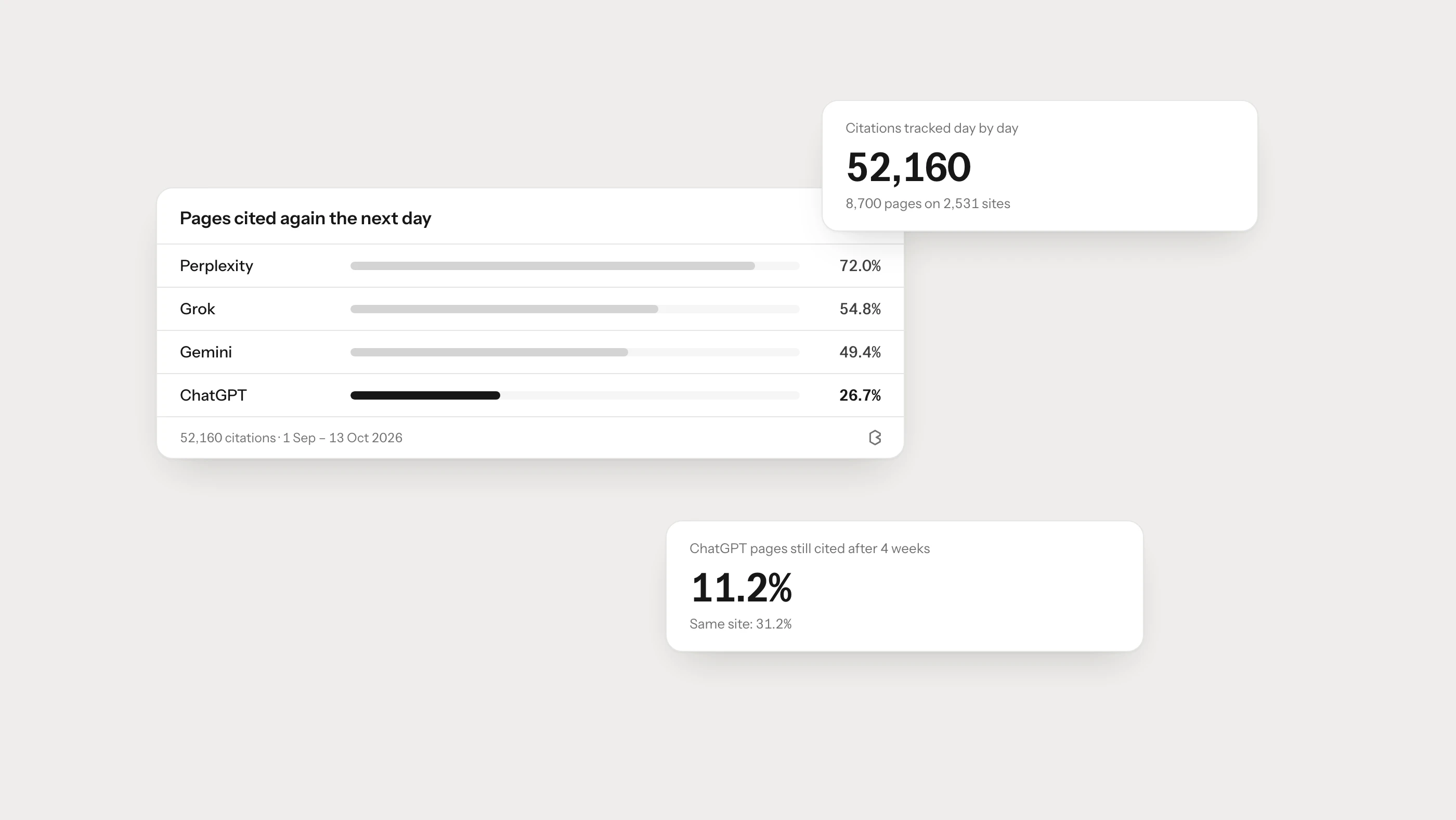
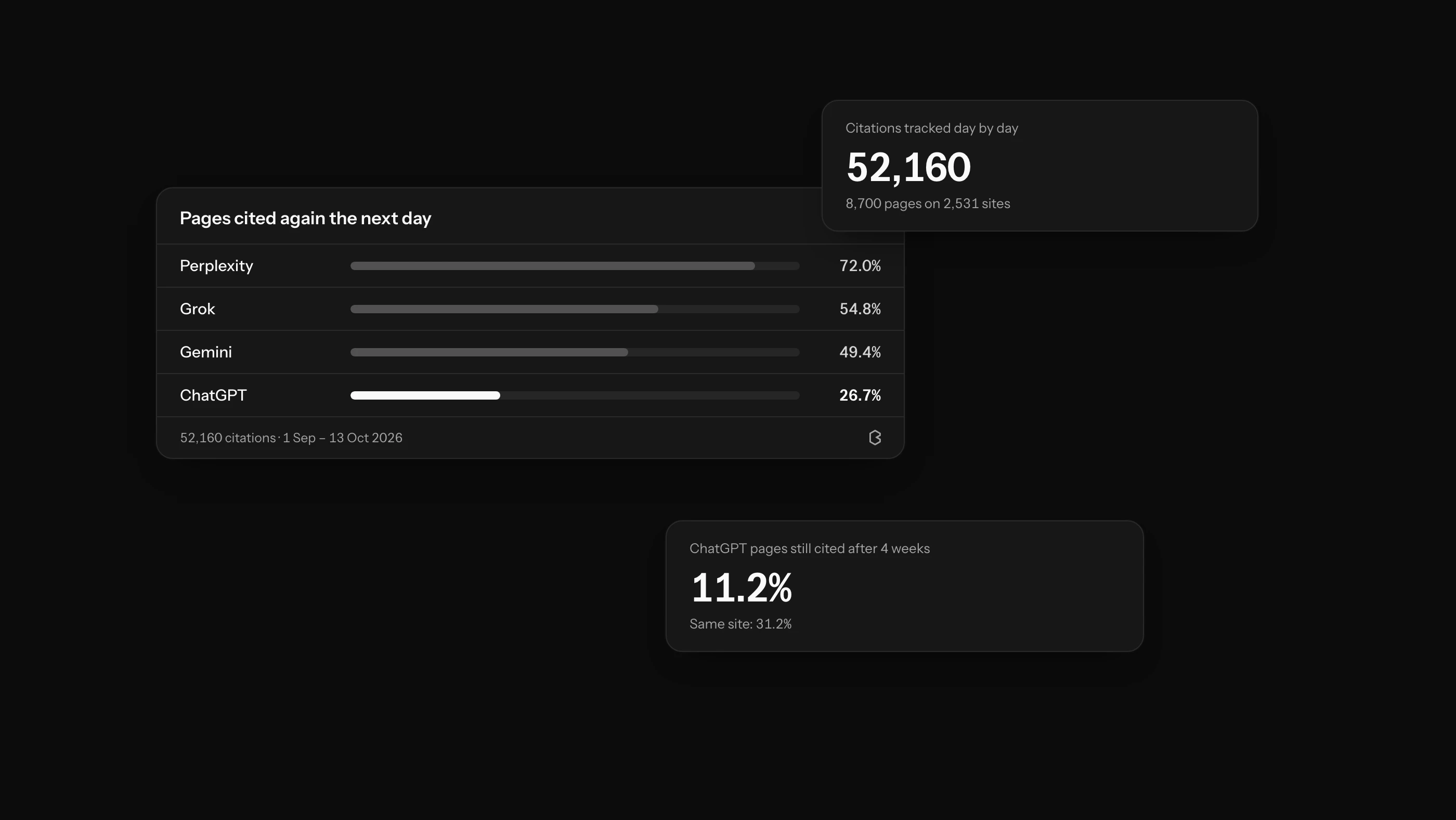
Most AI citations disappear within days. We asked AI engines the same questions every day for six weeks and followed 52,160 citations. When ChatGPT cited a page, it cited that same page again the next day only about a quarter of the time. Even Perplexity, the most consistent engine in the first days, had dropped more than four in five of its citations four weeks later.
For brands this changes what “we were cited” means. A citation is not a ranking you hold until someone overtakes you; it is a snapshot of one answer on one day. Here is how quickly it fades on each engine, and what that means for how you measure.
How we measured
The data comes from the questions Brantial tracks every day for its customers:
- Six weeks of daily answers, from 1 September to 13 October 2026.
- Four engines: ChatGPT, Gemini, Grok and Perplexity, queried through their APIs with web search available. Claude is not included because it was not measured daily in this period.
- 52,160 citations in 4,899 answers, pointing to 8,700 different pages on 2,531 sites.
- Same question, same engine, later date. A citation counts as kept if the same page appears among the sources when the same engine answers the same question again 1, 7, 14 or 28 days later. Only questions answered on at least 30 of the 43 days are included, so a missing day cannot pass for a lost citation.
How long does a citation stay in an AI answer?
Not long. The next day, between a quarter and three quarters of yesterday’s sources are still there, depending on the engine:
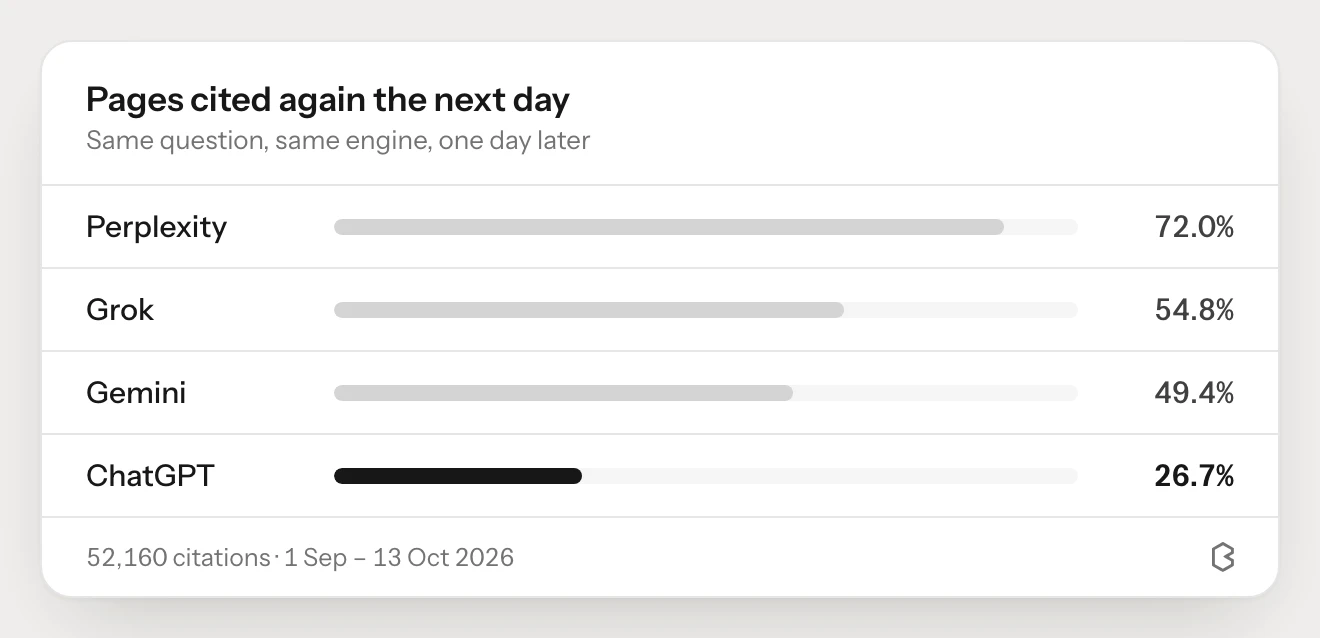
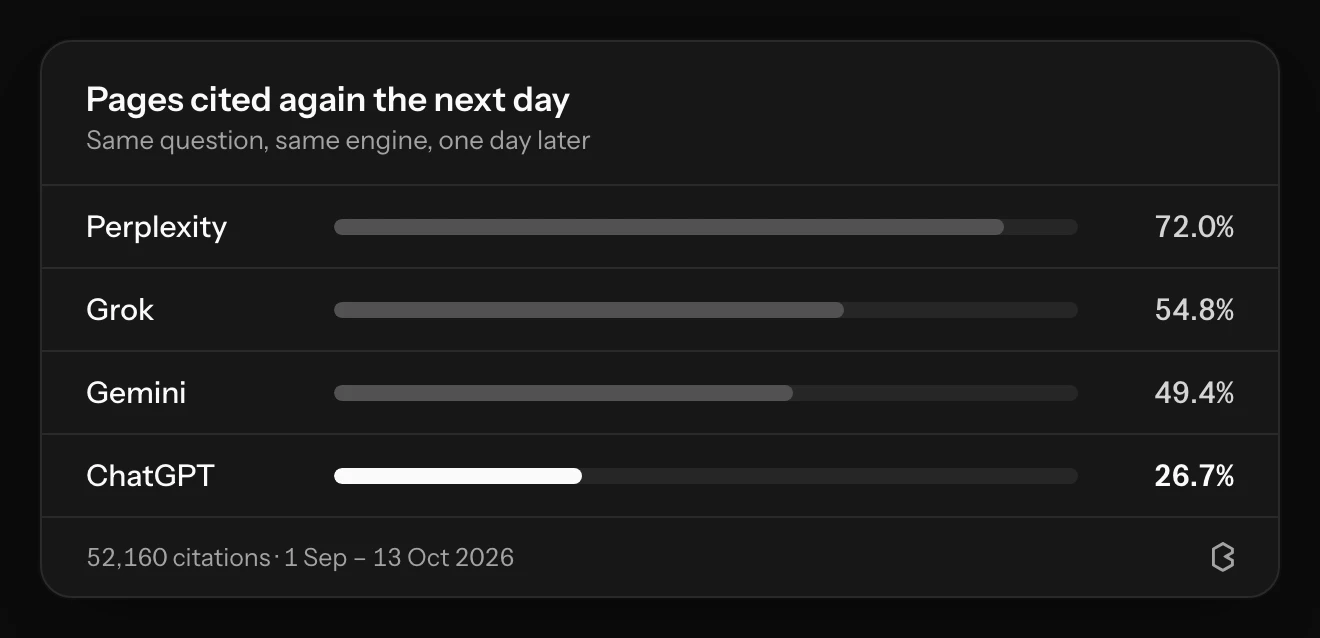
Perplexity is the most stable in the short run: 72.0% of the pages it cited were cited again the next day. Grok (54.8%) and Gemini (49.4%) keep about half. ChatGPT keeps 26.7%, which means three in four of the pages it shows today will be replaced tomorrow.
Measured by the time it takes for half of the citations to disappear, the “half-life” of an AI citation is:
- ChatGPT: less than a day
- Gemini: about one day
- Grok: about two days
- Perplexity: about three days
What is left after a week and a month?
The drop slows down after the first days, but it does not stop.
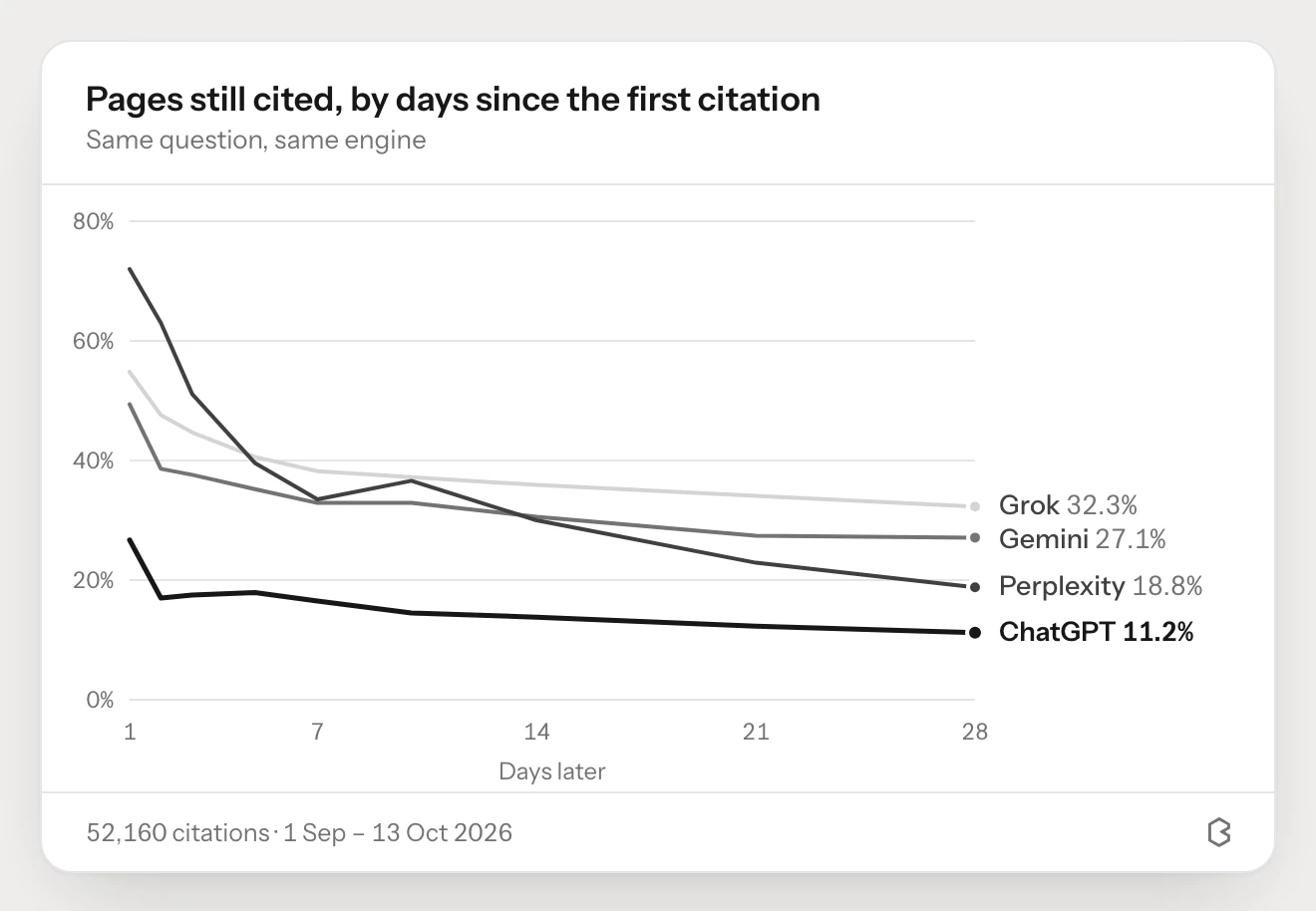
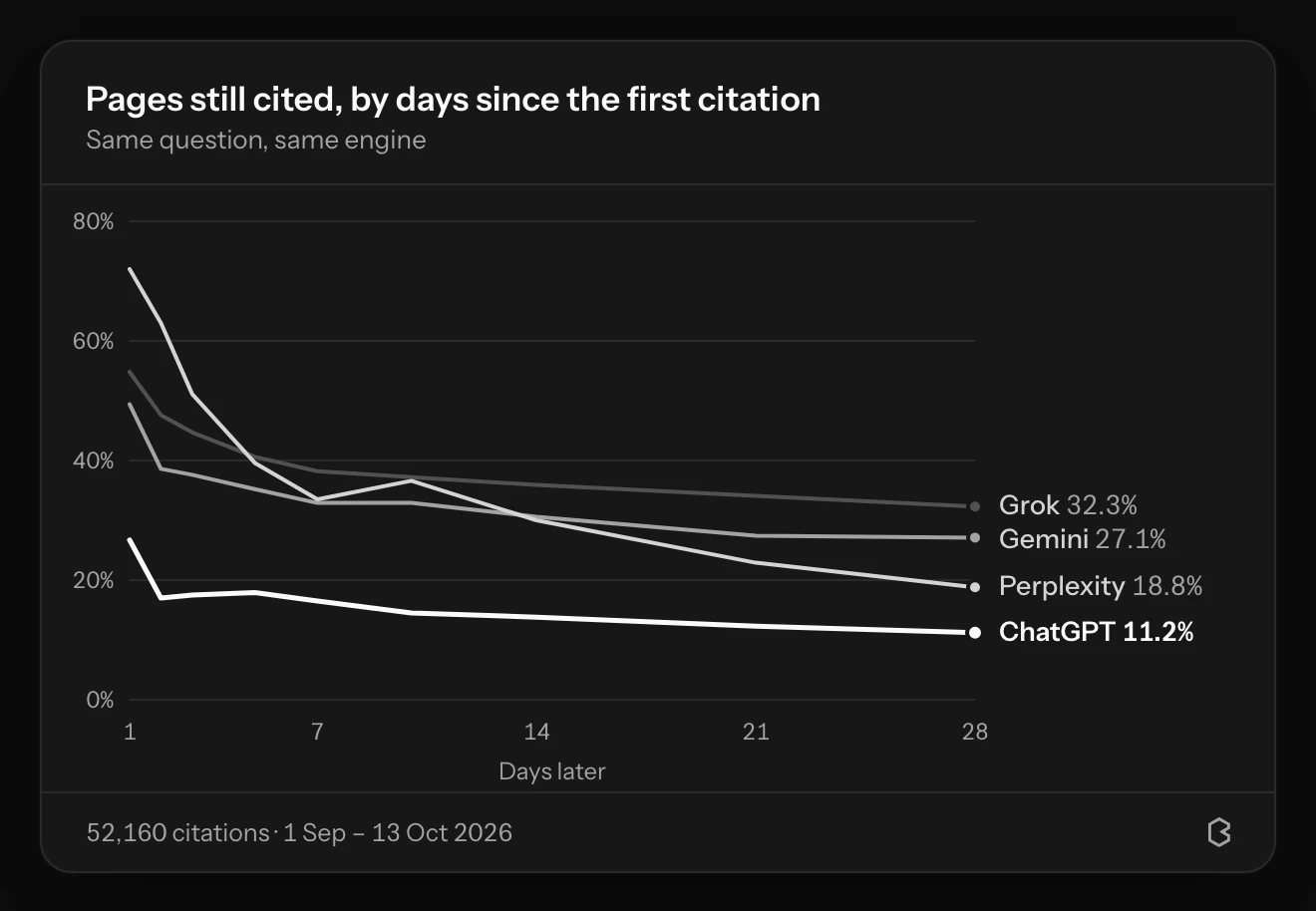
| Engine | Next day | After 1 week | After 2 weeks | After 4 weeks |
|---|---|---|---|---|
| ChatGPT | 26.7% | 16.5% | 13.8% | 11.2% |
| Gemini | 49.4% | 32.9% | 30.6% | 27.1% |
| Grok | 54.8% | 38.2% | 35.9% | 32.3% |
| Perplexity | 72.0% | 33.5% | 30.0% | 18.8% |
Two patterns stand out. Perplexity starts strong but loses its sources quickly after the first few days: by week four it keeps fewer than Gemini or Grok. Grok and Gemini lose most of what they will lose in the first week and then hold on to a stable core of about a third of their sources.
That stable core matters. On every engine there is a group of pages that keeps being cited week after week. The engine trusts those pages for that question, and they are the first ones to study in your category.
Do AI engines change sites or just pages?
Often just pages. When we count a citation as kept if the same site is cited again, rather than the same page, the numbers rise on every engine, and most of all on ChatGPT:
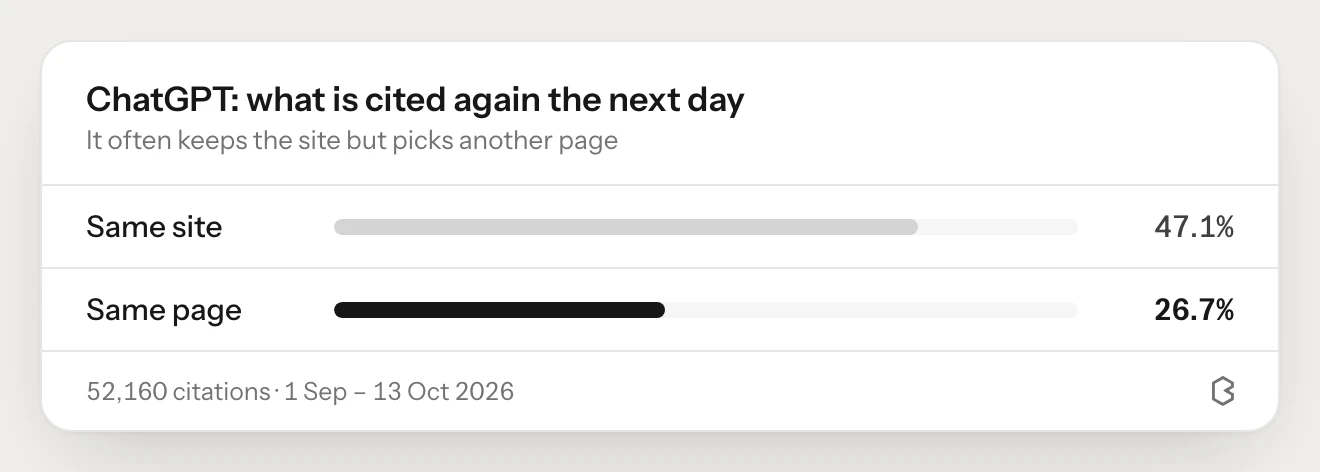
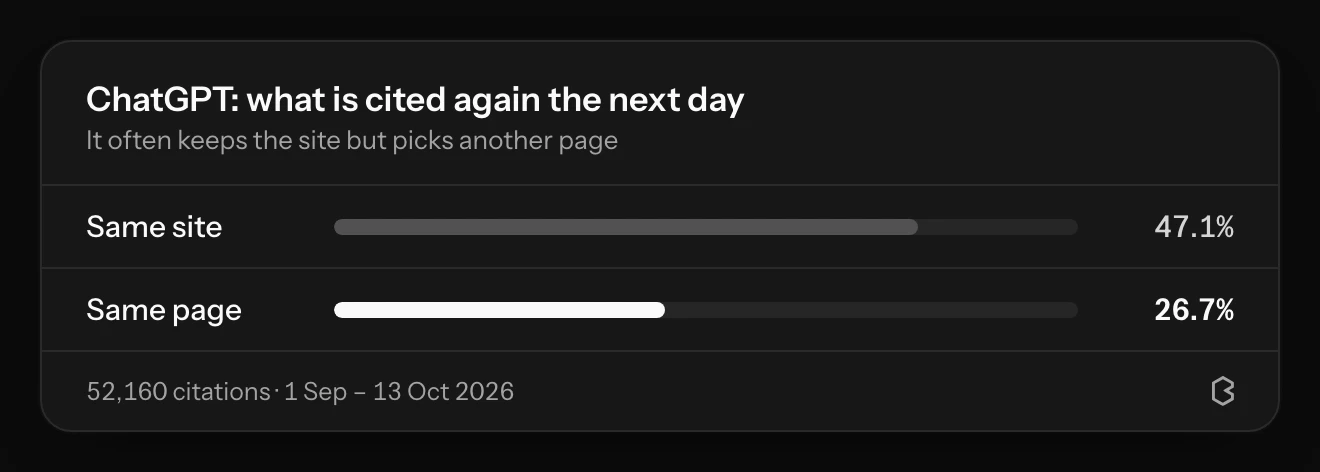
ChatGPT cited the same site again the next day 47.1% of the time, almost twice as often as the same page. After four weeks the same site was still there 31.2% of the time, against 11.2% for the same page. In other words, ChatGPT often stays with a site it trusts but picks a different page from it.
For a brand this is good news. Being one of the sites an engine returns to for a topic is more durable than any single page being cited. Several strong pages on the same topic give the engine more ways to keep citing you.
Why do AI citations change so fast?
The engines do not publish how they choose sources, but the behavior has clear contributing causes:
- Every answer runs a new search. When web search is on, the engine searches again each time, often with different wording. Small changes in the query bring back different pages. We explain this process in query fan-out.
- Answers are generated, not looked up. The same question can be answered with a different structure each time, and a different structure needs different supporting sources. This is why AI visibility changes over time even when nothing on your site changes.
- The web itself moves. New articles are published, old ones are updated, and search results shift with them. An engine that prefers fresh sources will keep replacing them.
- Engines cite few sources. ChatGPT shows the fewest sources per answer of the engines we track, so each slot is contested and turns over fastest. You can see how many sources each engine cites in which sites AI engines cite.
What this means for your brand
- Never judge AI visibility from a single check. One answer on one day shows a moment. To know whether you are really cited, ask the same questions repeatedly and count how often you appear. Our guide to how many prompts to track covers how many you need.
- Report citation rates, not citations. “We were cited in 40% of ChatGPT answers this month” is a measurement. “ChatGPT cited us” is an anecdote that may already be out of date.
- Build depth on your topics. Since engines often stay with a site while switching pages, several clear, answer-first pages on the same subject keep you in the answer longer than one strong page. Our guide to getting cited by AI explains how to write them.
- Find the sources that last in your category. The pages still cited after four weeks are the ones an engine relies on. Study them: getting your brand mentioned on those pages, or publishing a page that answers the same question as well as they do, is the most durable way in.
- Watch each engine separately. A page that holds steady on Grok may vanish from ChatGPT tomorrow. What counts as stable is different on every engine.
Frequently asked questions
How long does a citation stay in ChatGPT?
Usually not long. In our data ChatGPT cited the same page again the next day only 26.7% of the time, and 11.2% of the time four weeks later. Half of its citations had changed in less than a day. The same site, however, was cited again the next day 47.1% of the time.
Which AI engine keeps its sources the longest?
It depends on the time frame. Perplexity is the most stable over the first few days (72.0% of pages cited again the next day). Over a month, Grok (32.3%) and Gemini (27.1%) keep the most of their sources, while Perplexity drops to 18.8%.
Does losing a citation mean my content got worse?
Not necessarily. Citations change every day even when nothing on your site changes, because each answer runs a new search and is written anew. A single lost citation is noise; a falling citation rate across many repeated answers is a signal.
What is the half-life of an AI citation?
In our data it is less than a day on ChatGPT, about a day on Gemini, about two days on Grok and about three days on Perplexity. That is the time after which half of the pages an engine cited for a question are no longer cited for it.
How should I track AI citations?
Ask the same questions on each engine on a schedule, record every source each answer cites, and look at how often your pages appear over weeks rather than on a single day. Brantial does this for the questions you choose and shows the rate per engine.