

AI Read Your Page but Didn't Cite It: What Should You Fix?
Learn why an AI system may retrieve your page without citing it, how to diagnose the gap, and what to improve to earn more useful citations.
Key Takeaways
5- Being read and being cited are different stages. Retrieval makes a page a candidate; citation requires the page to support the final answer clearly enough to be selected.
- The most useful diagnosis compares the uncited page with the pages cited for the same prompt, answer and market.
- Direct answers, verifiable evidence, clear ownership, current facts and focused sections improve citation readiness more than repeating keywords.
- Technical eligibility still matters. A page that is difficult to crawl, render, index or canonicalize may lose before its content is evaluated properly.
- Measure the same prompt set before and after a change. Otherwise, a different answer sample can look like an improvement or decline that the page did not cause.
An AI system can visit your page, use it during retrieval and still leave it out of the sources shown with the final answer. This is one of the most useful gaps to find because the page is not invisible. It is already close enough to the question to enter consideration, but something prevents it from becoming supporting evidence.
That does not always mean the article is poor. The cited result may answer the exact subquestion more directly, contain stronger proof, present fresher information or simply fit that particular response better. The job is not to make the page sound more like an AI wrote it. The job is to understand why another source was easier to use.
This guide explains what “read but not cited” means, how to investigate it and which changes are most likely to improve the page for both people and answer engines.
What does “read but not cited” mean?
In practical terms, the page appeared during the system’s research or retrieval process but was not included among the sources attached to the answer. Retrieval and citation are separate decisions.
| Stage | Question being answered | What it means for the page |
|---|---|---|
| Discovery | Can the system find the URL? | Crawling, internal links and sitemaps matter. |
| Retrieval | Does the page appear relevant to the question? | Topic coverage, entities and intent matter. |
| Selection | Does a passage support the answer clearly and reliably? | Directness, evidence, freshness and focus matter. |
| Citation | Should this source be shown with the final response? | The page must earn a place among competing sources for that answer. |
A page can therefore be relevant without being the best source for the response that was ultimately generated. It may also support part of the model’s reasoning without receiving a visible citation. Different platforms expose different levels of this process, so “read” should be interpreted according to the data available in the tool being used, not as proof of every internal action taken by a model.
Google’s guidance for generative AI features says that its AI search experiences use core Search ranking and quality systems to retrieve current, relevant pages. Bing’s new AI Performance reporting also separates citation activity, cited pages and grounding queries. Both point to the same practical lesson: classic technical SEO gets a page into consideration, but the page still has to be useful enough to support a generated answer.
Why would AI read a page and not cite it?
There is rarely one universal cause. Start with the exact prompt and answer instead of judging the page in isolation.
The relevant answer is buried
The page may cover the subject but take too long to reach the useful fact. A broad introduction, several promotional sections or an oversized table can separate the question from the sentence that actually answers it.
This is not an argument for reducing every section to one sentence. It means the reader should receive the answer early, followed by the conditions and evidence needed to use it correctly.
The page makes a claim without enough support
“Best,” “fastest,” “most trusted” and similar claims are difficult to reuse when the page does not explain the method, date, sample or source. The same applies to prices, product limits, market statistics and legal requirements.
A source becomes safer to cite when a claim is accompanied by the information a careful reader would ask for next:
- Who produced the data?
- When was it collected or updated?
- What was measured?
- Which market, product or audience does it cover?
- What limitations should be understood?
The page answers the category, not the decision
A person asking for accounting software for a small manufacturer needs different information from someone asking for a freelance invoicing tool. A generic page about “the best accounting software” may be retrieved for both questions, yet cited for neither if it never addresses inventory, tax region, team access or integration needs.
The fix is not to insert every possible use case. Choose the decisions the page genuinely serves and make those boundaries clear.
Another source is more current
AI answers often depend on facts that change: prices, plan limits, supported countries, product capabilities, regulations and release status. A page with no visible update context can lose to a source that documents the same point with a clear date and maintained references.
Freshness is not achieved by changing the date alone. Review the facts, remove expired statements, update evidence and show the new date only when meaningful work was done.
Several URLs send competing signals
Duplicate pages, inconsistent canonicals, translated pages without correct hreflang, parameter URLs and near-identical campaign pages can make it unclear which version represents the information. Search systems may retrieve one URL while another accumulates authority or contains the stronger answer.
Before rewriting, confirm that the intended URL is indexable, canonical, internally linked and not competing with an older version of itself.
The important content is difficult to access
Key facts may appear only after a click, inside a client-rendered interface, in an image without supporting text or behind a blocked resource. Human visitors with a modern browser may see the page correctly while a crawler receives incomplete HTML.
Check the rendered page, not only the source file. Product specifications, comparison criteria and primary answers should remain understandable without relying on a decorative graphic or a hidden interaction.
The answer has limited room for sources
Not every relevant page can be cited in every answer. A response may use a small number of sources, prefer primary documentation for one claim and choose an independent comparison for another. Citation visibility is competitive and can vary between runs even when the page has not changed.
This is why one isolated answer is not enough to evaluate a content change.
How to diagnose the citation gap
The fastest useful workflow compares three things: the question, the generated answer and the sources that won.
1. Start with one commercially meaningful prompt
Avoid diagnosing a broad topic such as “CRM software.” Use a question that represents a real decision, for example:
Which CRM is suitable for a 30-person B2B sales team that needs HubSpot migration, EU data hosting and Salesforce reporting?
Record the country, language, answer engine and date. A different market or model can produce a different set of candidates.
2. Mark the claims in the answer
Separate the response into the claims a source would need to support. In the example above, those claims may concern migration, data location, reporting compatibility, price and team size.
This makes the comparison concrete. You are no longer asking why the whole page lost. You are asking which specific claim the cited source supported better.
3. Compare your page with the cited pages
Read the cited pages as a researcher, not as a competitor looking for words to copy. Compare:
| Check | Your page | Cited page |
|---|---|---|
| Does it answer the exact constraint? | ||
| Is the answer visible near the relevant heading? | ||
| Are claims supported by primary evidence? | ||
| Are dates, markets and limitations clear? | ||
| Does the page identify the author or publisher? | ||
| Is the relevant text accessible in rendered HTML? |
The difference often becomes obvious. The cited page may contain a maintained comparison table, a documented limitation or a direct paragraph your page never provides.
4. Check technical eligibility
Inspect the final URL, HTTP status, canonical, robots directives, rendered HTML, internal links and sitemap presence. Confirm that the page can appear with a search snippet. Google states that a page must be indexed and eligible to appear in Search with a snippet before it can be considered as a supporting link in AI Overviews or AI Mode.
If the wrong canonical is selected or the important copy is missing from rendered HTML, editorial changes alone will not solve the problem.
5. Choose the smallest useful change
Do not rewrite a strong page simply because it missed one citation. Improve the part that failed:
- add a direct answer under the relevant heading
- replace an unsupported claim with dated evidence
- clarify who the page is for and when the advice does not apply
- consolidate duplicate URLs
- add a comparison criterion the reader genuinely needs
- link to the maintained primary document behind a fact
- update a stale price, feature or availability statement
Small, focused changes are easier to measure and less likely to damage sections that already perform well.
A practical rewrite framework
Use this structure for the section that needs improvement:
- Direct answer: Resolve the question in one or two natural sentences.
- Conditions: Explain when the answer changes by market, product, plan or use case.
- Evidence: Add the current source, method, date or product documentation.
- Trade-off: State an important limitation instead of hiding it.
- Next step: Help the reader compare, verify or act.
Here is a simple example:
| Weak version | More useful version |
|---|---|
| “Our platform offers enterprise-grade security.” | “The Enterprise plan supports SAML SSO and SCIM provisioning. Data residency is available in the EU and US; customers that require another region should confirm availability before procurement.” |
| “This plan is ideal for growing teams.” | “The plan includes 10 editor seats. Teams that need more editors should compare the additional-seat cost before choosing annual billing.” |
| “We integrate with leading CRMs.” | “The native integration syncs contacts and companies with HubSpot. Deal-stage updates require the workflow connector described in the setup guide.” |
The improved versions are not longer for the sake of length. They answer the question, define the boundary and give the reader something verifiable.
How to measure whether the change worked
Use a fixed prompt group rather than checking one answer immediately after publication.
- Record the current mention rate, citation rate, answer position and cited URLs for the target prompts.
- Save the uncited pages and the competing sources shown for those same prompts.
- Publish the focused change and document what was edited.
- Keep the prompts, engines, countries and language stable.
- Compare consistent time periods and inspect which URL gained or lost source presence.
- Read AI referral traffic and conversions alongside visibility, not as a substitute for it.
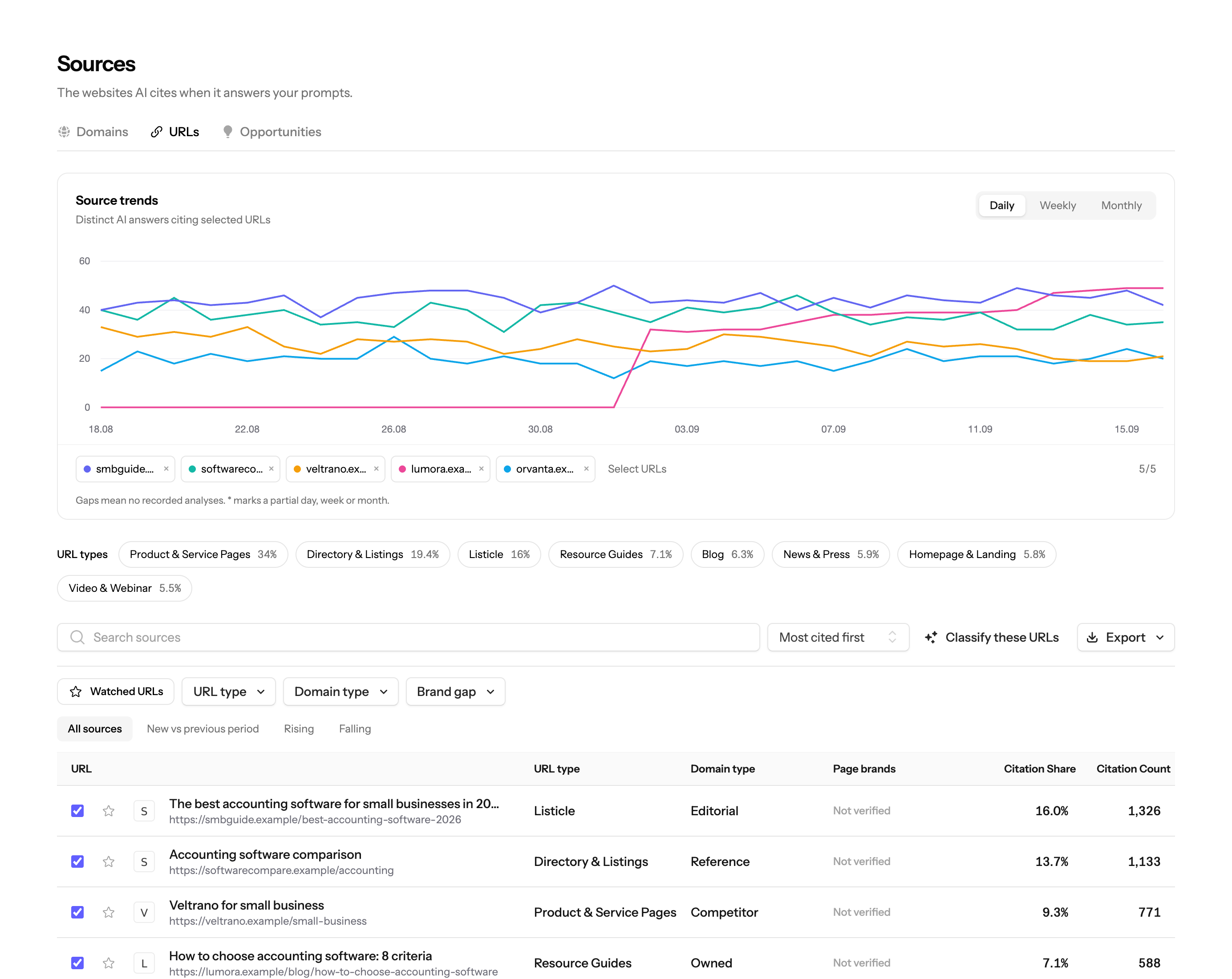
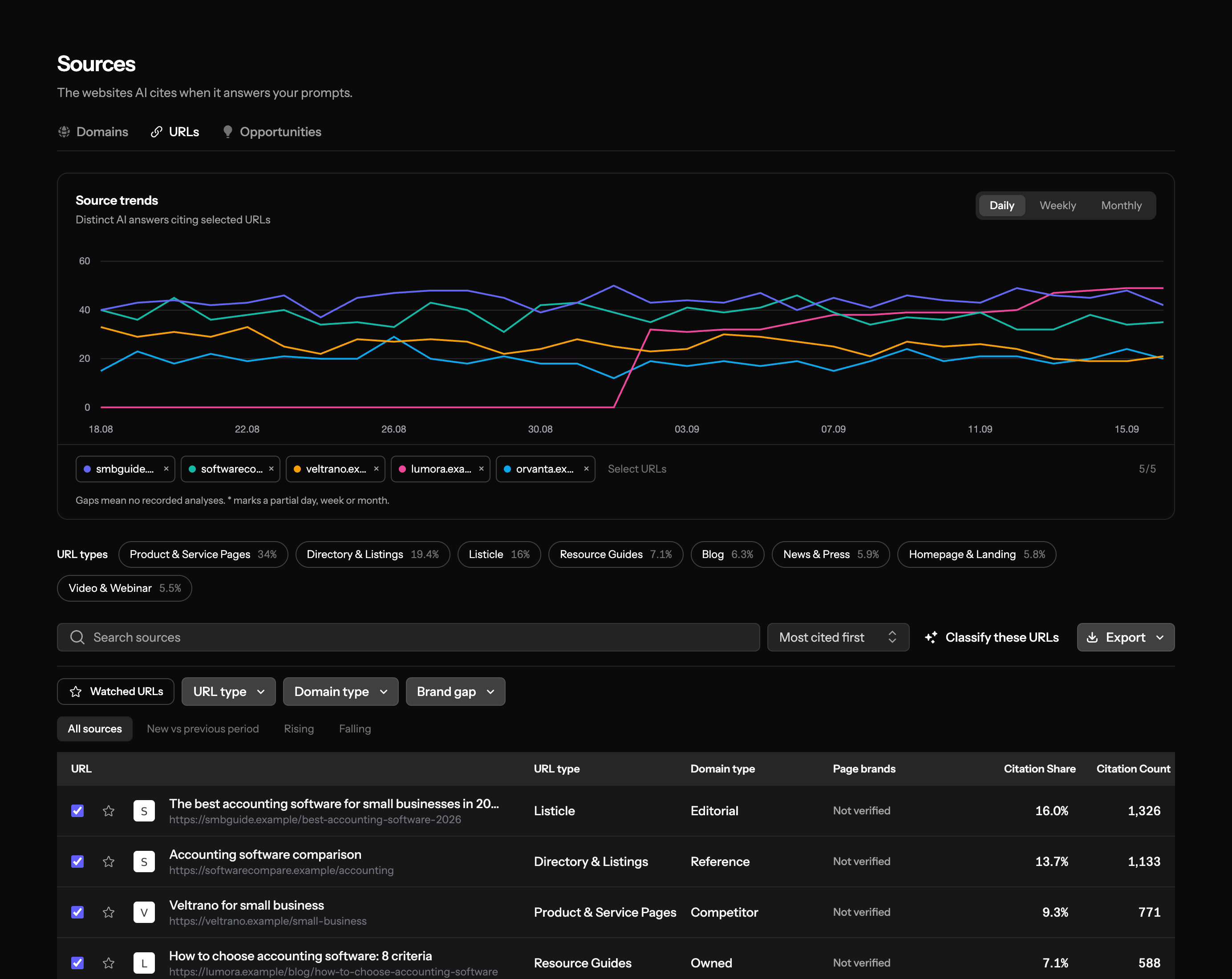
An increase in citations is useful, but it is not the only possible success. The improved page may gain mentions, appear for a more relevant prompt group or drive fewer but better-qualified visits. The business outcome should remain part of the review.
What not to do
Do not copy the cited page
Copying its structure or wording removes the reason to cite your page. Learn which information need it satisfies, then answer that need using your own expertise, data and product knowledge.
Do not publish a page for every prompt variation
Several prompts can express the same intent. Creating near-identical URLs spreads evidence and authority across weak pages. Strengthen one useful resource when the purpose is shared.
Do not manufacture studies, customers or statistics
An impressive number without a defensible method creates risk for readers and for the brand. If original data is unavailable, use a clear example or rely on a maintained primary source.
Do not treat llms.txt as a citation switch
An llms.txt file may help describe important resources to systems that choose to use it, but it does not replace crawling, indexing, internal links, useful content or evidence. It cannot guarantee a citation.
Do not measure too soon or change the prompt set
Pages need time to be crawled and processed, and AI answers naturally vary. Changing the prompts after publication makes the before-and-after comparison unreliable.
Frequently asked questions
Is “read but not cited” a technical error?
Not necessarily. It can reveal a technical problem, but it often means the page was relevant enough to retrieve and another source supported the final answer more clearly. Diagnose both the technical page and the competing content before deciding what to change.
Is a mention the same as a citation?
No. A brand can be named in an answer without a link to its website, and a website can be cited as a source without the brand becoming the main recommendation. Track mentions, citations, position and source URLs separately.
Can structured data guarantee an AI citation?
No. Valid structured data can help search systems understand eligible content and entities, but it does not force a model to cite the page. The visible page still needs to support the answer accurately.
How long does it take to see a change?
There is no fixed period. Crawling frequency, indexing, the answer engine and prompt volatility all affect timing. Measure over a consistent window and confirm that the updated URL has been recrawled before drawing a conclusion.
Should I rewrite the entire page?
Usually not. Preserve sections that are accurate and useful. Start with the passage connected to the missed citation, make the smallest meaningful improvement and measure the same prompt group again.
The practical conclusion
A page that was read but not cited is not a dead end. It is a qualified candidate that did not win a place in that answer. That is a more actionable problem than complete invisibility.
Begin with the exact prompt. Identify the claim the answer needed. Compare the selected sources with your page, check technical eligibility and improve the smallest section that closes the evidence gap. Then measure the same prompts over time. The goal is not to make content look optimized for a machine. It is to make the page easier for a person, a search system and an answer engine to understand and trust for the same reasons.