

AI Shopping Prompt Research: How to Find the Questions Buyers Ask
Learn how to build an AI shopping prompt set from real customer language, reviews and search data, organized by journey stage, without inventing demand.
Key Takeaways: AI Shopping Prompt Research
5- AI shopping prompt research starts with customer language from support, onsite search, sales, reviews, and search data, not a list generated from one seed keyword.
- Separate observed questions from synthetic variants. Generated prompts can improve coverage, but they are not proof of real demand or search volume.
- Organize prompts by journey stage, product attributes, constraints, audience, use case, and comparison target so the set reflects how people make decisions.
- Track a stable core set over time and keep exploratory prompts separate; otherwise visibility changes cannot be compared fairly.
- A useful prompt set should lead to content, catalog, feed, and product-page decisions rather than becoming a large spreadsheet nobody acts on.
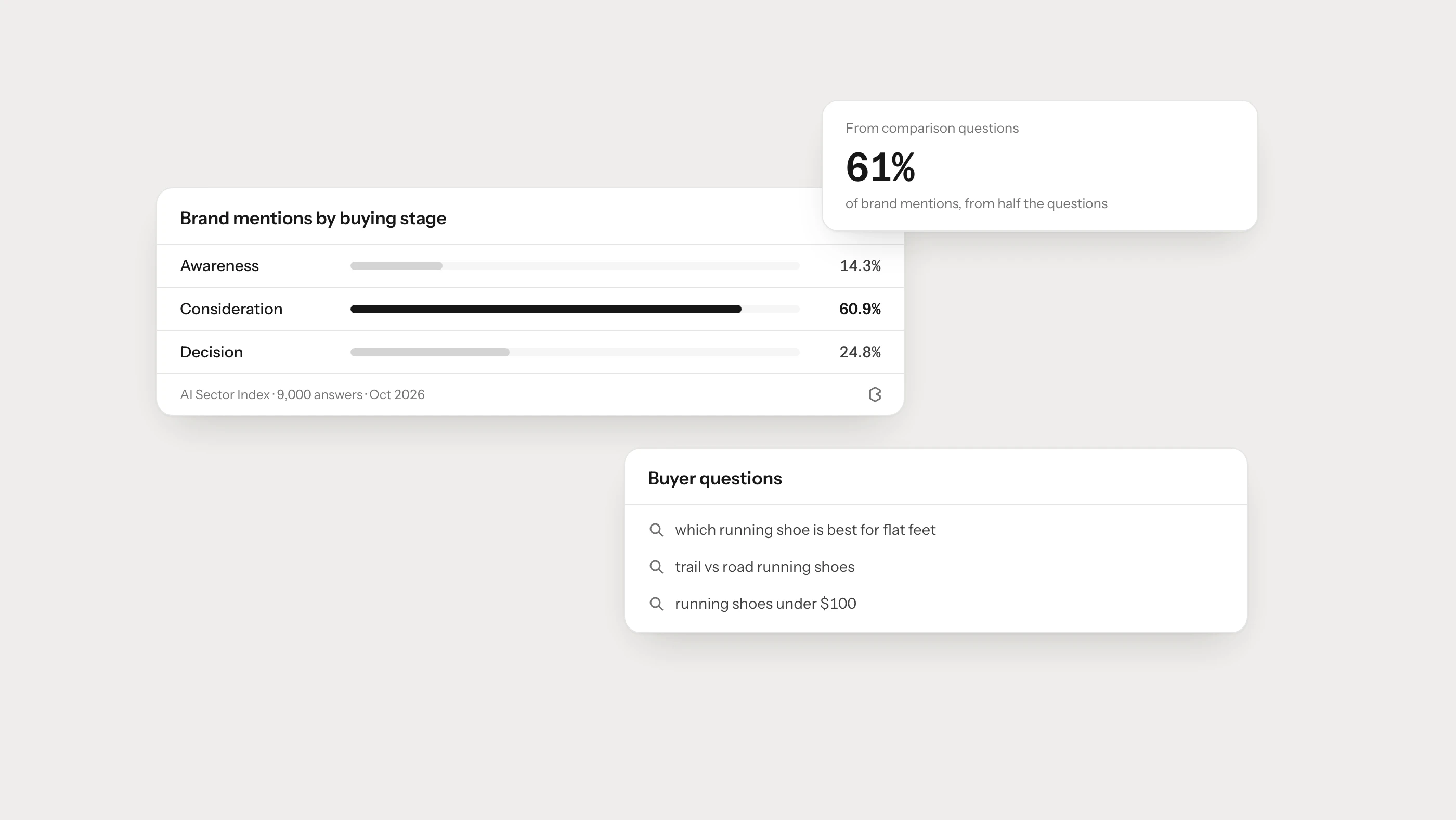
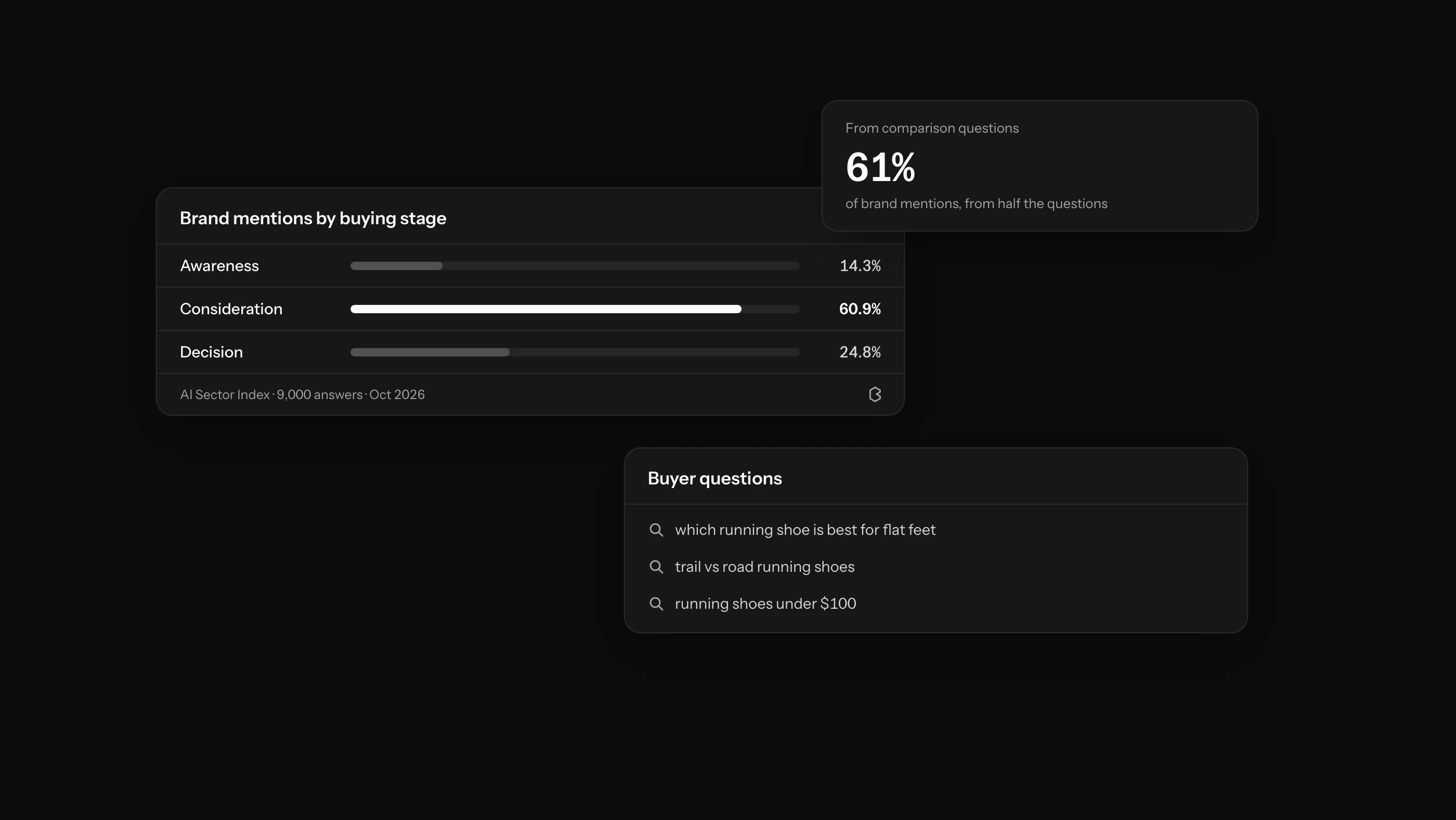
AI shopping prompt research is the process of finding the questions people use to discover, compare, validate, and choose products in answer engines. The goal is not to generate hundreds of keyword-like sentences. It is to build a representative, traceable set of buying questions that can guide content and measure visibility.
There is no public database of every private ChatGPT conversation. Be precise about what your evidence can show. Customer support records can prove that a question was asked; Search Console can show Google demand; a generated variation can expand coverage. These are useful in different ways, but they are not interchangeable.
Where Should Shopping Prompts Come From?
Start with first-party language, then use external discovery and synthetic expansion.
| Source | What it reveals | Limitation |
|---|---|---|
| Customer support tickets and chat | Real concerns, compatibility questions, objections, post-purchase confusion | Often biased toward existing customers and problems |
| Onsite search | The words visitors use inside your catalog | Empty-result queries may be noisy; volume belongs only to your site |
| Sales calls and store teams | Comparison language, buying criteria, reasons deals stall | Needs consistent note-taking and privacy controls |
| Search Console | Queries that already expose your pages in Google | Does not represent private answer-engine prompt volume |
| Reviews and Q&A | Benefits, failures, use cases, and attributes in customer language | Competitor or marketplace samples may not represent your audience |
| Category and product data | Brands, models, materials, sizes, compatibility, price bands | Catalog language may be internal rather than natural |
| Manual answer-engine observation | How engines interpret a question and which sources they use | Small samples vary by date, market, model, and personalization |
| Generated prompt variants | Coverage across phrasing, constraints, and journey stages | Synthetic prompts are hypotheses, not observed demand |
When you use public communities or reviews, summarize patterns rather than copying identifiable customer text into a research sheet. Follow the source’s terms and your organization’s privacy policy.
Build a Prompt Taxonomy Before Expanding the List
Shopping questions become easier to manage when each one has a clear job.
Discovery
The buyer knows the problem or category but may not know the product.
- What is a good lightweight stroller for a small car?
- Which running shoe types suit wet trails?
Constraint and fit
The decision depends on a requirement such as compatibility, budget, size, material, location, or delivery date.
- Which coffee grinders fit under a 40 cm cabinet?
- Is this charger compatible with a 2024 MacBook Air?
Comparison
The buyer is choosing between models, brands, technologies, or price bands.
- What is the difference between Model A and Model B for apartment use?
- Is a heat-pump dryer worth the higher price for a family of four?
Validation
The buyer wants evidence before trusting a claim.
- Does this rain jacket stay waterproof after repeated washing?
- What warranty applies to the battery?
Purchase and availability
The buyer is ready to act and needs current commercial information.
- Where can I buy the blue 128 GB version for delivery this week?
- Is assembly included in the listed price?
Post-purchase
These questions may not create an immediate sale, but they shape satisfaction, returns, and future recommendations.
- How do I clean the filter without damaging it?
- Which replacement part fits this model?
Use all six stages where they apply. A set made only of “best product” questions misses the detail that often decides the purchase.
A Step-by-Step Prompt Research Method
1. Define the market and decision
Specify language, country, category, audience, and the business decision the research will support. “Headphones” is too broad; “wireless over-ear headphones for remote workers in the UK” provides a workable boundary.
2. Gather observed language
Export a privacy-safe sample from onsite search, support categories, Search Console, approved sales notes, reviews, and product Q&A. Keep the original wording before you normalize it; unusual phrases often reveal how customers actually think.
3. Extract decision dimensions
Mark the entities and constraints that change the answer:
- product type and subtype,
- audience or user,
- problem and intended use,
- price band,
- material, size, color, and capacity,
- compatibility,
- geography and availability,
- comparison brand or model,
- evidence requirement such as warranty, test, or certification.
4. Create natural variants
Expand the observed questions across missing stages and constraints. Read every prompt aloud. If it sounds like an SEO keyword string rather than something a person would ask, rewrite or remove it.
Avoid producing ten variants that differ only by “best,” “top,” and “recommended.” A smaller set with distinct decision needs is more informative.
5. Deduplicate by intent
Two sentences can use different words but require the same answer. Place them in one cluster and choose a representative tracking prompt. Keep variants for content research, not necessarily for recurring measurement.
6. Validate against the catalog and content
For each cluster, ask:
- Do we sell a suitable product?
- Is the relevant attribute present and reliable in the catalog?
- Does a public page answer the question?
- Can the claim be supported?
- Would the answer change by market, stock, or date?
A prompt that exposes missing compatibility data may be more valuable than one where the brand already appears.
7. Test answer engines consistently
Record the engine, model or experience where visible, date, market, language, exact prompt, brand mentions, cited URLs, competitor, and answer accuracy. Do not treat one manual conversation as a stable ranking.
8. Freeze a core measurement set
Keep a stable core for comparisons and a separate exploratory set for discovery. Add or retire a core prompt only with a documented reason. This protects trend data from silent methodology changes.
Recommended Prompt Research Sheet
| Column | Example or purpose |
|---|---|
| Prompt ID | Stable internal identifier |
| Exact prompt | The question exactly as tested |
| Language and market | en-GB, United Kingdom |
| Category and product | Headphones / Model A |
| Journey stage | Comparison |
| Constraint | Calls in a noisy home office |
| Source type | Support, onsite search, Search Console, review, synthetic |
| Evidence reference | Aggregated report, query export, or research note |
| Observed or synthetic | Never leave this ambiguous |
| Target page | The page that should answer the question |
| Engine and date | Required for reproducible observations |
| Mention and citation | Brand present? Which URL was cited? |
| Accuracy issue | Wrong price, outdated model, missing caveat |
| Owner and action | Content, catalog, technical, PR, or no action |
Do not put unsupported “monthly AI search volume” into the sheet. If a platform or tool estimates demand, retain the provider, market, method, and collection date with the value.
Turn Prompt Research Into Site Improvements
A prompt cluster should point to a specific improvement:
- No relevant page: create or expand a category guide, comparison, FAQ, or support article.
- Page exists but is not cited: inspect access, rendering, internal links, evidence, and competitor coverage.
- Answer contains wrong product data: align page, structured data, and feed values.
- Competitor wins on a supported claim: publish the missing proof, method, specification, or policy.
- Prompt has no business fit: do not create content simply because a question can be generated.
For page-level work, use the ecommerce product page AI search checklist. For catalog delivery, see ChatGPT Product Feed Requirements. Technical gaps can be reviewed through the AI Site Audit Checklist and Brantial Site Health.
How to Measure Whether the Prompt Set Is Useful
Track more than brand presence:
- citation coverage across the core set,
- percentage of cited pages that are the intended current page,
- factual accuracy of price, availability, compatibility, and policy claims,
- competitor share by prompt cluster,
- unanswered or weakly answered questions,
- referrals and assisted conversions where analytics can observe them,
- content, feed, and catalog fixes completed from the research.
Brantial Prompt Volumes can help organize and prioritize question groups. Whatever tool you use, preserve the exact prompt, language, market, engine, and date so the result has context.
Frequently Asked Questions
Is AI prompt research the same as keyword research?
No. They overlap, but prompts are often longer, more conditional, and closer to a conversation. Keyword data remains useful evidence; it should not be converted into fake conversational volume.
How many prompts should a brand track?
There is no universal number. Start with enough questions to cover important categories, journey stages, and constraints without creating clusters you cannot review. A disciplined set of 50 can be more useful than 2,000 near-duplicates.
Can an AI model generate the entire prompt list?
It can propose variants and reveal missing dimensions, but the list still needs first-party evidence, human review, deduplication, and business validation. Label generated prompts as synthetic.
How often should prompt research be updated?
Review exploratory prompts monthly or around launches and seasonal changes. Keep the core tracking set stable and revisit it quarterly, recording every change.