

How Many Prompts Should You Track for AI Visibility?
Learn how to build a representative AI visibility prompt set, separate branded and unbranded questions, and choose between a focused 50-prompt or expanded 150-prompt portfolio.
Key Takeaways
5- Different prompts improve coverage; repeating one prompt several times improves confidence in that prompt. These solve different measurement problems.
- Brantial measures more than 3.1 million prompts per day. Our Türkiye AI visibility research examines 42,000 Turkish prompts across 14 sectors and six answer engines. That scale strengthens category benchmarking, but it does not remove the need for a carefully designed brand-level prompt set.
- Branded and unbranded prompts should be reported separately because a brand named in the question is almost guaranteed to appear in the answer.
- Keep a stable core set for trend measurement and a separate exploratory set for discovering new questions, competitors and sources.
- A focused 50-prompt portfolio can support one category and market. A 150-prompt portfolio is more suitable when several products, audiences or markets must be measured separately.
A team tracks 12 versions of “What are the best tools in our category?” and gets a visibility score of 58%. The number looks precise, but the sample may say very little about the buying journey.
It does not show whether the brand appears when a customer first describes the problem, compares two approaches, asks about an important limitation or checks whether the product fits a specific industry. Adding another 20 versions of “best tools” would make the spreadsheet longer without fixing the coverage.
So, how many prompts should a brand track for AI visibility?
There is no single number that works for every company. The right prompt count is the smallest set that represents the decisions your customers make and remains stable enough to compare over time. For a focused product in one market, 50 well-chosen prompts can provide a useful operating baseline. A company with several products, audiences or regions may need 150 or more.
The count matters, but the composition matters more.
What Brantial’s measurement scale tells us
Brantial’s live measurement infrastructure operates on a broad panel so that visibility can be compared across sectors. Its current platform coverage is:
| Measurement scope | Brantial data |
|---|---|
| Prompts processed daily | 3.1 million+ |
| Türkiye research sample | 42,000 prompts |
| Live answer engines | 6 |
| Brands tracked weekly | 100 |
| Sectors covered | 14 |
The 42,000-prompt Türkiye AI visibility study compares 14 sectors across six answer engines. The panel of more than 3.1 million daily prompts describes Brantial’s broader measurement infrastructure. These figures do not mean that one brand should track millions of prompts. A recurring brand-level set should remain focused enough to represent real customer decisions and to be reviewed responsibly. The 50- and 150-prompt portfolios below describe that manageable core, not the platform’s total data volume.
Why prompt count affects the result
AI answers are variable. A brand may appear in a response today and disappear tomorrow. Sources can change even when the brand list remains similar. When the tracked set is very small, normal variation can move the overall percentage enough to look like a strategic gain or loss.
The arithmetic shows why. In a ten-prompt set, one changed brand mention moves the visibility result by ten percentage points. In a 50-prompt set, one answer represents two points. In a 150-prompt set, it represents about 0.7 points. A larger set does not remove answer variability, but it reduces the influence of any one response and makes it easier to identify patterns across groups.
A larger set helps only when the added prompts cover distinct decisions. One hundred near-duplicates do not create the same insight as 100 questions distributed across customer needs, funnel stages and use cases.
Coverage comes before count
Before deciding whether the list should contain 50 or 150 prompts, define what it must represent.
Customer journey
The set should cover the stages where AI can influence a decision:
- Problem discovery: The customer describes a goal or difficulty without naming the category.
- Category discovery: The customer asks which type of solution could help.
- Consideration: The customer asks for suitable products, providers or approaches.
- Comparison: The customer compares options, features, prices or trade-offs.
- Validation: The customer checks evidence, security, compatibility, limitations or reviews.
- Purchase or implementation: The customer asks where to buy, how to start or what adoption requires.
Not every business needs the same balance. A direct-to-consumer retailer may need more purchase and availability questions. A B2B platform with a long sales cycle may need more validation, integration and procurement questions.
Topic and product coverage
List the products, solution areas and jobs the business genuinely wants to be associated with. Each major area needs enough questions to reveal a pattern. If 40 prompts concern the flagship product and two concern a new service, their visibility scores should not be treated as equally reliable.
Do not create a separate prompt for every keyword variation. Group questions by the answer they require. If “best payroll software for startups” and “which payroll tool suits a new company?” lead to the same decision and evidence, one can remain in the recurring set while the other stays in research notes.
Audience and constraints
Recommendations can change when the user adds context such as team size, industry, budget, geography, technical requirement or experience level. Include a variation only when that context could reasonably change the right answer.
Useful dimensions include:
- customer segment or company size
- industry or regulated environment
- main use case
- budget or pricing model
- integration and compatibility requirement
- location and language
- risk, security or policy requirement
The goal is not to multiply every prompt by every possible persona. It is to represent the segments the business serves and the constraints that affect selection.
Market and language
The same question can produce a different shortlist in the United States, Türkiye, the United Kingdom or Germany. Sources, availability and well-known brands also change by language.
If market-level decisions matter, keep the same core intent across each important market and report the results separately. Do not merge English and Turkish answers into one percentage and assume the average describes either audience accurately.
Different prompts and repeated runs answer different questions
Two measurement choices are often confused:
| Measurement choice | What it improves | Question it answers |
|---|---|---|
| Add distinct, relevant prompts | Coverage of customer decisions | Are we measuring enough of the market and buying journey? |
| Repeat the same prompt several times | Confidence for that individual question | Is this answer a recurring pattern or one variable result? |
| Run the set on more answer engines | Platform coverage | Does the brand perform consistently across different engines? |
| Continue the same set over time | Trend visibility | Did the pattern change after a market or content change? |
Running ten prompts ten times is not equivalent to tracking 100 distinct prompts. The first approach studies repeatability in a narrow area. The second covers more decisions but may run each one only once per measurement period.
Repetition is useful when a team needs to understand how stable one commercially important answer is. Broader coverage is more useful when the goal is to measure the market, customer journey or product portfolio. For portfolio-level tracking, start by covering distinct and relevant decisions. Add repeated runs selectively for high-risk questions where a single response could otherwise lead to the wrong action.
Separate branded and unbranded prompts
Branded and unbranded questions measure different things.
Unbranded prompts measure discovery
These questions do not contain the company name:
- What is the best invoicing software for a small agency?
- Which analytics platforms track visibility in AI answers?
- How can a retailer audit product data for AI shopping?
They show whether the answer engine discovers and recommends the brand without being instructed to discuss it.
Branded prompts measure evaluation and perception
These questions contain the brand or product name:
- Is Brand A suitable for an enterprise team?
- What are the limitations of Brand A?
- Brand A or Brand B for a UK retailer?
- Does Brand A support SSO?
They are useful for checking positioning, objections and factual accuracy. However, they should not be mixed into the main discovery score. If the prompt names the brand, its presence in the answer is expected and can inflate visibility.
Use separate groups and separate reporting. Unbranded visibility tells you whether the brand enters the shortlist. Branded evaluation tells you what the customer learns after the brand is already under consideration. Our AI brand perception guide explains how to audit the second group in more detail.
Keep a core set and an exploratory set
A prompt library has two jobs that should not be forced into one list.
Core prompts
Core prompts support comparison over time. They should represent important, recurring decisions and remain unchanged long enough to establish a baseline. Preserve their exact wording, market, language and grouping.
Change the core set when the business changes, not because one weekly result looks disappointing. A new product, a new priority market or a retired service can justify an update. Record the date and reason so the reporting break is visible.
Exploratory prompts
Exploratory prompts help the team learn. They can come from sales calls, support questions, onsite search, Search Console, reviews, new competitors, product launches and observed query fan-outs. Test them without immediately adding them to the historical benchmark.
Promote an exploratory prompt to the core set when it represents a recurring customer decision, has business relevance and produces an answer the team can act on. Retire it when it is merely a wording duplicate or falls outside the market the company serves.
This separation protects the trend line while allowing the research process to evolve.
A practical 50-prompt portfolio
Fifty prompts can be enough for a focused business measuring one main category, one priority market and a limited number of customer segments. The allocation below is an example, not a universal formula.
| Group | Prompts | What the group should cover |
|---|---|---|
| Problem and awareness | 10 | Needs and obstacles before the customer names a solution |
| Category and use-case discovery | 15 | Broad category, job-to-be-done and important audience variations |
| Comparison and decision criteria | 10 | Alternatives, features, trade-offs and price considerations |
| Validation and implementation | 5 | Security, evidence, integrations, limitations and setup |
| Branded perception and accuracy | 5 | Objections, factual checks and direct comparisons |
| Exploratory reserve | 5 | New questions tested without changing the main baseline |
| Total | 50 |
If the company sells directly online, move some validation prompts into purchase and availability. If it sells an enterprise service, use them for procurement, risk and implementation instead.
A practical 150-prompt portfolio
An expanded set is useful when the company needs separate views by product line, audience or market. Increasing the count should create better segmentation, not a larger undifferentiated score.
| Group | Prompts | What the additional coverage provides |
|---|---|---|
| Problem and awareness | 25 | Several needs, categories and early-stage questions |
| Category and use-case discovery | 45 | Product lines, jobs, segments and high-value constraints |
| Comparison and decision criteria | 30 | Competitor groups, trade-offs and commercial evaluation |
| Validation and implementation | 20 | Evidence, policies, integrations, technical and adoption concerns |
| Branded perception and accuracy | 15 | Positioning, objections, facts and direct comparison |
| Exploratory reserve | 15 | Emerging topics, new markets and observed customer language |
| Total | 150 |
Do not calculate only one company-wide percentage from this list. Tag prompts by product, stage, audience and market. A stable total can hide a serious decline in the segment that produces most revenue.
How to build the set step by step
1. Define the business boundary
Write down the product scope, priority market, language, customer segments and decisions the measurement will support. “Measure AI visibility” is too broad. “Measure whether UK marketing teams discover and shortlist our analytics platform” is usable.
2. Collect real customer language
Use approved, privacy-safe evidence from:
- Search Console queries
- sales and discovery call themes
- support categories and FAQs
- onsite search
- product reviews and customer research
- category pages and comparison questions
- relevant prompt and topic demand data
AI can expand the list, but generated suggestions are hypotheses rather than proof of demand.
3. Map every prompt to a decision
Give each prompt a topic, journey stage, audience, market and business owner. If the team cannot explain what decision a prompt represents, it probably does not belong in the recurring set.
4. Deduplicate by intent
Read the prompts as questions, not keyword strings. Merge versions that need substantially the same answer. Preserve meaningful differences such as budget, industry, compatibility or geography.
5. Balance the groups
Check whether one easy-to-write group dominates the portfolio. “Best,” “top” and “recommended” questions often crowd out problem discovery, validation and implementation. Correct the balance before the first baseline run.
6. Freeze the baseline
Record the exact prompts, engine, market, language, date and group definitions. Run the same core set for at least several weeks before treating ordinary movement as a trend. The separate guide to prompt volatility explains why isolated answers are not a reliable benchmark.
7. Review the answers, not only the score
For each group, inspect:
- brand mention rate
- average answer position
- competitor presence
- cited domains and URLs
- sentiment and recurring descriptions
- factual errors
- pages read but not cited
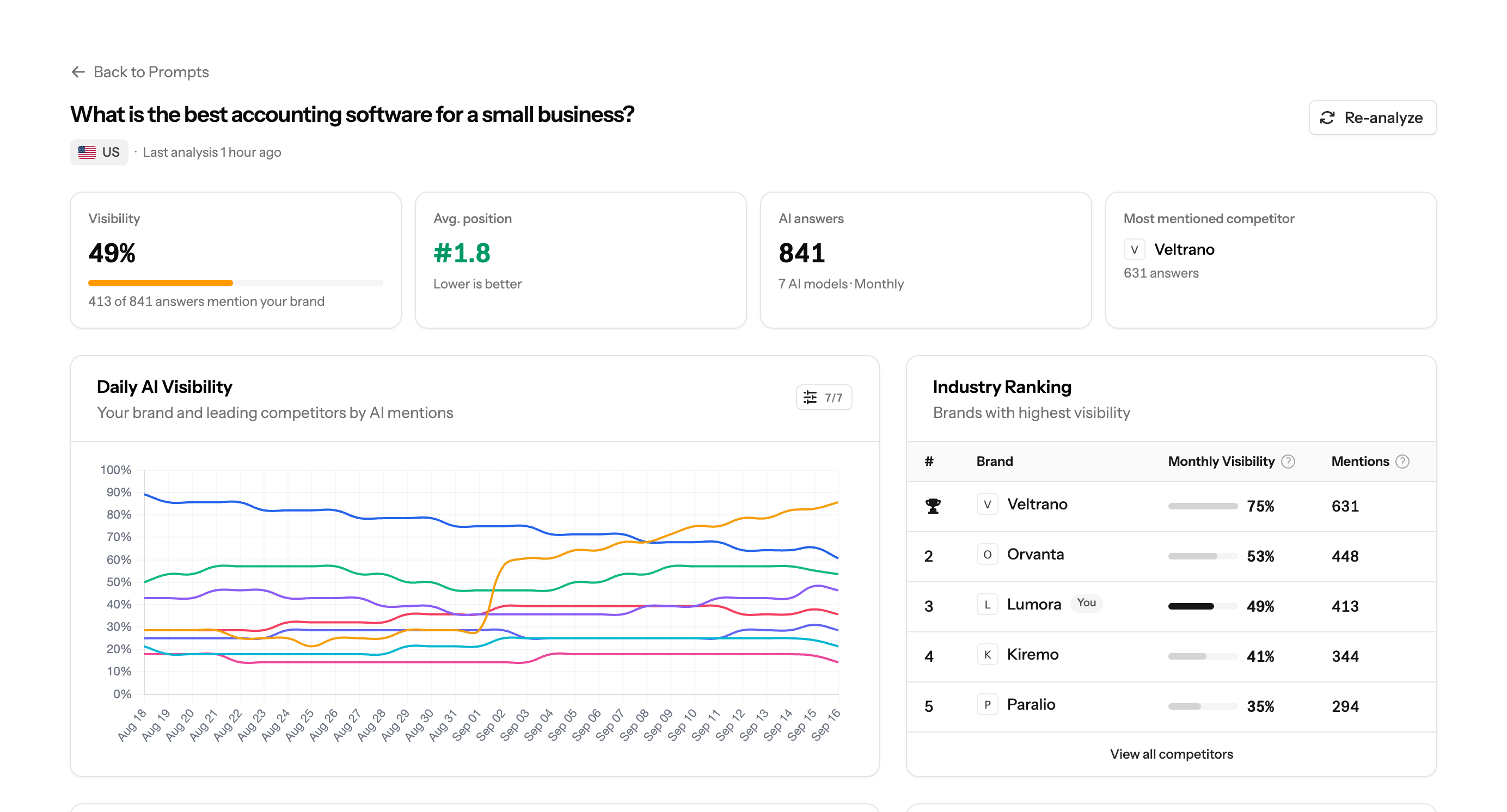
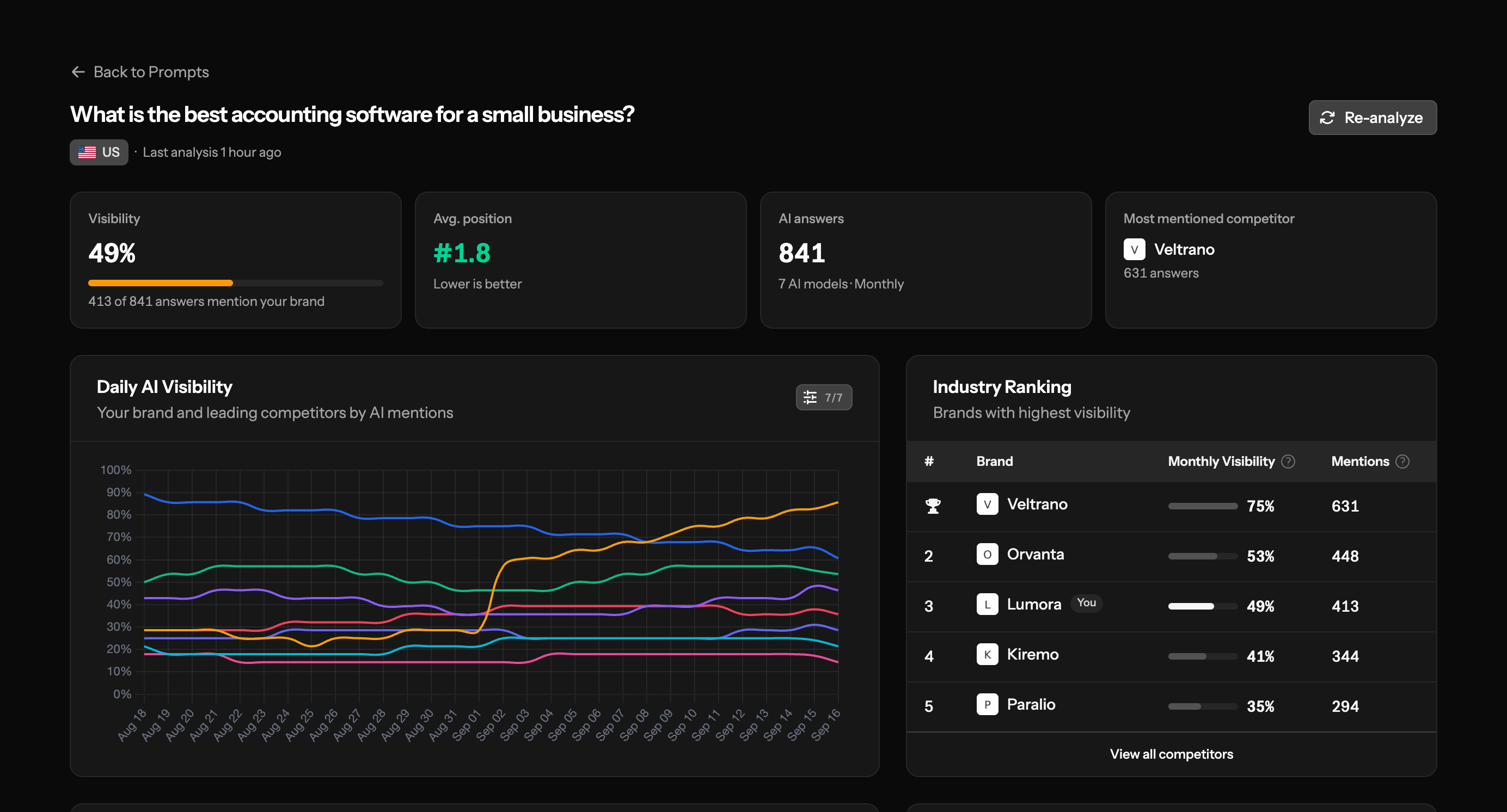
The score reveals where to look. The answer and source show what the team may need to change.
How to know the prompt set is too small
The set probably needs broader coverage when:
- adding or removing one prompt changes the total score dramatically
- almost every prompt is a variation of “best category”
- major products or customer segments are represented by only one or two questions
- the list contains no unbranded discovery questions
- a priority market is inferred from another language or country
- the dashboard looks healthy while sales and support teams recognize none of the questions
- the team cannot separate a real movement from the appearance or disappearance of one brand mention
A larger number is not automatically the answer. First identify the missing decision or segment, then add prompts that represent it.
How to know the set is too large
The portfolio may be unnecessarily large when:
- many prompts require the same answer and cite the same pages
- no one reviews the underlying responses
- the team cannot connect a prompt group to a product, page or owner
- low-value markets and hypothetical personas dilute priority segments
- prompts are added continuously but never retired or reclassified
- reporting depends on one aggregate score that hides all segmentation
Tracking has an operational cost. Every prompt consumes collection, review and interpretation time. The best set is not the largest one the tool permits. It is the largest one the team can use responsibly.
Frequently asked questions
Is 50 prompts enough for AI visibility tracking?
It can be enough for one focused category and market when the set covers distinct customer decisions. It is less likely to be sufficient for several products, languages, regions and audiences. Review coverage by group rather than treating 50 as a universal threshold.
Should every prompt be run on every answer engine?
Use the engines your audience actually uses and keep the engine mix consistent when comparing periods. Running the same core set across several relevant engines reveals platform differences. It does not require creating different prompt wording for every engine unless the user behavior or product experience genuinely differs.
Should branded prompts count toward visibility?
Track them, but report them separately. A branded prompt is useful for perception, comparison and accuracy checks. It is not a fair measure of whether the brand was discovered without assistance.
How often should the prompt list be updated?
Review exploratory prompts monthly or around material product and market changes. Review the core set quarterly, but change it only for a documented business reason. Preserve historical versions so a methodology change is not mistaken for a visibility change.
Is prompt volume enough to choose what to track?
No. Demand estimates can help prioritize, but relevance, customer value and decision coverage also matter. A lower-volume procurement question may be commercially more important than a broad, high-volume question with little purchase intent.
Can an AI model generate the whole prompt list?
It can suggest wording and missing dimensions, but it cannot prove which questions your customers ask or which decisions matter most to the business. Use first-party evidence, human review and deduplication before adding generated prompts to the core set.
Conclusion
The right number of prompts is not a vendor benchmark to copy. It is a coverage decision.
Start with the customer journey, products, audiences and markets that matter. Separate branded evaluation from unbranded discovery. Keep a stable core for measurement and an exploratory set for learning. Use 50 prompts when the business scope is focused and each question has a clear role. Expand toward 150 when the additional prompts create meaningful product, audience or market views.
Most importantly, keep the set usable. A carefully balanced portfolio that the team reviews and acts on is more valuable than hundreds of generated questions sitting behind one impressive but unexplained percentage.